

High in the Rif mountains of northern Morocco, a small town tumbles down a hillside in every shade of blue. Chefchaouen, or simply Chaouen to Moroccans, is one of the most photographed places in the country, and one of the most relaxing. There are no great monuments to tick off and no hurry. People come to walk its painted lanes, sit on its square, climb to a viewpoint at sunset and breathe mountain air. This guide covers its history, what to see and do, and the practical details for planning a visit.
01A Short History
Chefchaouen was founded in 1471 by Moulay Ali Ben Rachid, a descendant of the Prophet, as a small fortress from which to resist the Portuguese, who had taken the ports of the northern coast. Its name comes from the Amazigh word for horns, after the two peaks that rise above the town.
Within a generation it changed character. When the Christian kingdoms conquered Granada in 1492, Muslim and Jewish families expelled from Spain crossed the strait and settled here. They brought with them the architecture of Andalusia: whitewashed houses with tiled roofs, interior patios, wrought-iron balconies and small gardens. That heritage is still visible in every street.
For centuries the town was closed to outsiders and considered holy; only a handful of European travellers entered it, in disguise, before the twentieth century. Spain occupied it in 1920 and it remained part of the Spanish protectorate until Moroccan independence in 1956. Spanish is still widely understood here, more so than French.
02Why Is It Blue?
Everyone asks, and nobody can answer with certainty. The explanation most often given is that Jewish residents, whose numbers grew in the 1930s, painted their quarter blue as a reminder of the sky and of heaven, and that the custom spread. Others say the colour keeps houses cool, or that it discourages mosquitoes, or simply that it represents the water of the mountain spring to which the town owes its existence.
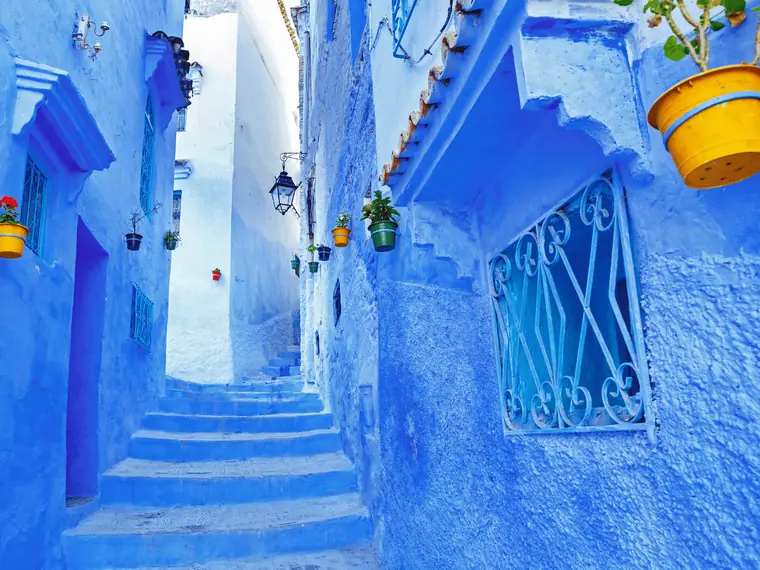
What is certain is that the people of Chefchaouen maintain the tradition with pride. Walls, steps and doorways are repainted regularly, often before the spring, with a wash of lime mixed with pigment. The shades range from pale ice to deep indigo, and they shift with the light through the day, which is why photographers find it hard to leave.
03The Medina and Its Square
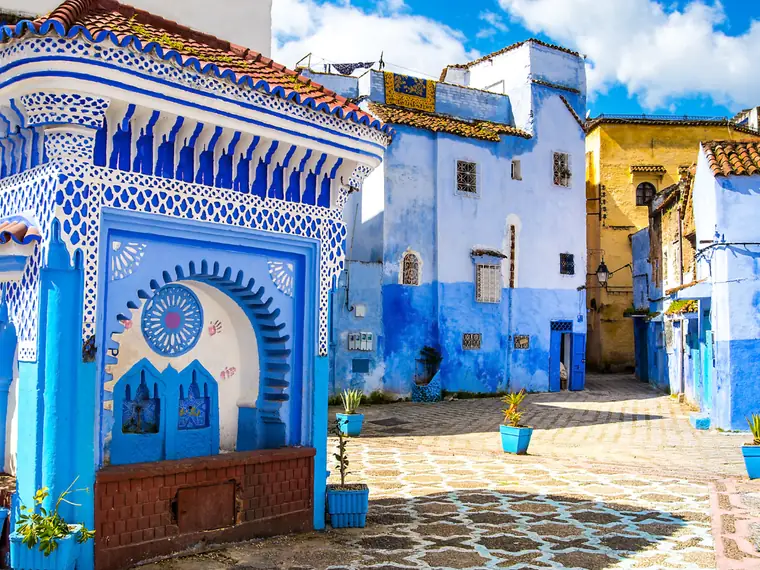
The old town is compact, and getting lost in it is a pleasure rather than a problem: walk downhill and you reach a gate; walk uphill and you reach the spring. Its lanes climb in steps, turn under arches and open into tiny squares with a fountain or a mulberry tree. Flowerpots hang on the walls, cats sleep on doorsteps, and old men in woollen djellabas with pointed hoods sit talking in the shade.
At its heart is the Plaza Uta el-Hammam, a cobbled square shaded by a great tree and lined with café terraces. On one side stands the Grand Mosque, with an unusual octagonal minaret, said to have been built by the son of the town’s founder. Beside it rise the red earthen walls of the kasbah.
From the square, lanes lead up through the quarter of the weavers, where men still work on wooden looms, to the old Andalusian quarter and its famous blue staircases. The most photographed corners are busiest between ten and four; go before nine and you will have them to yourself.
Chefchaouen has no list of sights to complete. Its great attraction is the town itself.

04What to See
The kasbah
The fortress built by the founder in the fifteenth century now contains a peaceful Andalusian garden, a small ethnographic museum with costumes, instruments and photographs of the town, and the former prison cells. Climb the tower for a view across the tiled roofs to the mountains.
Ras el-Maa
Just outside the north-eastern gate, the spring that supplies the town bursts from the rock and runs down past stone washing places, where local women still do laundry and rinse carpets. Cafés set their chairs in the stream in summer. It is the coolest place in Chefchaouen on a hot afternoon.
The Spanish Mosque
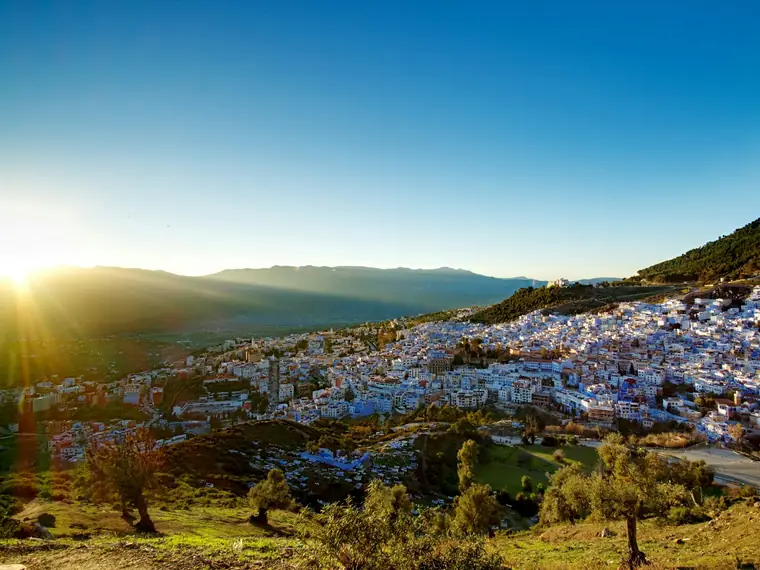
From Ras el-Maa a path climbs in about twenty minutes to a small white mosque built by the Spanish in the 1920s on a hill facing the town. It was never used for prayer. Today its terrace is the place to be at sunset, when the whole blue medina lies opposite you and the call to prayer rises from below.
The upper town
Fewer visitors climb to the gate of Bab el-Ansar and the highest lanes, where daily life goes on undisturbed: children playing, bread carried to the communal oven on a board, neighbours talking across the street.
05Into the Rif: Akchour and Talassemtane
Chefchaouen stands at about 600 metres, at the foot of limestone summits that rise above 2,000. Behind it lies the Talassemtane National Park, a landscape of gorges, cedar and Moroccan fir found almost nowhere else in the world. For walkers it is a different Morocco: green, wet and wooded.
The most popular excursion is Akchour, about forty-five minutes away by road. From the car park, one path follows a river of clear green water past pools and small cascades to a tall waterfall, a walk of around two hours each way. Another, shorter and steeper, leads to God’s Bridge, a natural arch of rock spanning the gorge high above the river. Simple cafés along the path cook tagines on the bank and cool drinks in the stream.
Closer to town, a half-day walk climbs from the medina through olive groves to hamlets and viewpoints above. In winter the summits can carry snow, and the paths are muddy; from April to October conditions are ideal.

06What to Eat and What to Buy
Food
The cooking of the north is simple and good. Breakfast might be bissara, a thick soup of dried broad beans with olive oil and cumin. The local fresh goat’s cheese, mild and soft, is served with bread and honey or in salads. Tagines here are often made with olive oil from the surrounding hills, and you will find dishes with a Spanish accent. In the evening, the terraces of the square fill with people drinking mint tea.
Crafts
Chefchaouen is a town of weavers. Look for woollen blankets in stripes of red and white, the pompom-trimmed cloth that country women wear around the waist, and thick djellabas. Leather bags, painted woodwork and baskets are also made locally. Small stalls sell bags of powdered pigment in brilliant colours, a favourite souvenir. Prices are generally fair and the selling is far gentler than in the big cities, which makes it a pleasant place to shop.
07When to Visit
The Rif has four distinct seasons, and it is wetter and cooler than the rest of Morocco.
 Spring (Mar – May)Green hills, wildflowers, freshly painted walls and mild days.
 Summer (Jun – Aug)Warm and busy, with cool evenings. Ideal for swimming at Akchour.
 Autumn (Sep – Nov)Soft light, olive harvest and fewer visitors.
 Winter (Dec – Feb)Cold and often rainy, sometimes snowy. Quiet, with heated riads.
08Getting There and How Long to Stay
Chefchaouen has no airport and no railway, which is part of its charm. By road it is about two hours from Tangier, an hour and a half from Tetouan and around four hours from Fes, through hills of olive and cork oak. It fits naturally between Tangier and Fes on a tour of the north, and it can be visited in a long day from either city.
We recommend at least one night, and two if you want to hike. Day visitors arrive in the late morning and leave by late afternoon; the town is at its most beautiful before and after them, in the first light and at dusk. Cars cannot enter the medina, so luggage is carried from the gates to your riad, and many streets are stepped: pack lightly and wear shoes with a good grip.
09Practical Tips
Small things worth knowing before you go:
- Photograph with courtesyThese lanes are people’s homes. Ask before photographing residents, do not block doorways, and note that a few decorated corners ask for a small fee.
- Start earlyThe famous staircases are empty at eight in the morning and crowded at noon.
- Bring a layerEvenings are cool all year at this altitude, and winter nights are cold.
- CashThere are bank machines near the main square, but small shops and cafés take cash only.
- Decline politelyThe Rif is known for growing kif. You may be offered some in the street; a firm “no, thank you” is all that is needed.
- FridaySome shops close around midday prayers on Friday; the town is quieter and very pleasant.
10A Perfect Day in Chefchaouen
Wake early and go out before breakfast. At eight the shopkeepers are still sweeping their doorsteps, the light is soft, and the blue staircases that will be crowded by noon are empty. Climb through the Andalusian quarter to the top of the town, then drift back down to your riad for breakfast on the roof.
Spend the late morning in the kasbah and its garden, then take a table on the square and watch the town go by over a glass of tea. After lunch, when day visitors fill the centre, walk out to Ras el-Maa and follow the stream, or rest through the warmest hour as the locals do.
Around five, wander the weavers’ lanes and do your shopping while the light turns golden. An hour before sunset, set off up the path to the Spanish Mosque. Sit on the wall with everyone else, residents and travellers together, and watch the blue deepen as the lamps come on below. Walk down by twilight and have dinner in the medina: a goat’s cheese salad, a tagine cooked in local olive oil, and oranges with cinnamon.
If you have a second day, give it to the mountains. Leave for Akchour after breakfast, walk to the waterfall or to God’s Bridge, eat lunch beside the river and be back in town for one more evening on the square.
11Chefchaouen: Frequently Asked Questions
How many days do I need in Chefchaouen?
One night is enough to see the town at its best in the evening and early morning. Stay two nights if you want to hike to Akchour.
Is Chefchaouen worth visiting?
Yes. It is one of the most beautiful and relaxed towns in Morocco, and very different from the big imperial cities.
Can I visit Chefchaouen on a day trip?
Yes, from Tangier, Tetouan or Fes. The drive is long from Fes, so a private vehicle and an early start are recommended.
What is the best time of day for photographs?
Early morning for empty lanes and soft light, and sunset from the Spanish Mosque for the view over the whole town.
Is Chefchaouen safe?
Yes. It is a small, calm town where visitors walk comfortably day and evening.
