

Chefchaouen may be the most photogenic town in Morocco. Every corner seems composed: a blue wall, a terracotta pot, an arched door, a figure in a pointed hood disappearing up a stairway. That is exactly why it is hard to photograph well. The same few corners appear in a million pictures, the lanes are narrow and often crowded, and the famous blue plays tricks on a camera. This article proposes a walk through the medina designed for people with a camera or a phone in their hand, with advice on light, colour and courtesy along the way. Think of it as a short course in Chefchaouen photography, taught on foot.
01Before You Set Out: Light and Timing
Two facts shape photography in Chefchaouen. The first is that the town faces west and lies under a mountain to its east. The sun does not reach the lanes until well after sunrise, and for the first hours of the day the medina is filled with soft, even, bluish light with no hard shadows. This is the best light of all for the painted streets.
The second is people. Day visitors arrive from about ten o’clock, and from then until late afternoon the well-known lanes are busy, sometimes with a queue at the most famous steps. Before nine you will have them almost to yourself, sharing them only with residents on their way to the bakery and the shopkeepers washing down their doorsteps.
The conclusion is simple. Stay the night, set an alarm, and be out by half past seven. Walk for two hours, go back for breakfast on the roof, rest through the middle of the day when the light is harsh and the streets full, and go out again from five. The route below follows that rhythm.
02First Light: The Upper Medina
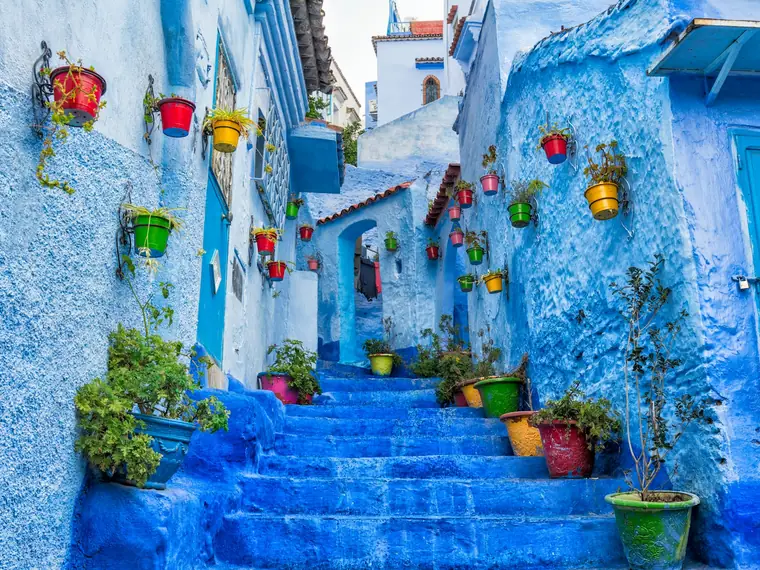
Begin at the top. From the main square, Plaza Uta el-Hammam, take any lane that climbs to the right of the kasbah and keep going uphill into the old Andalusian quarter. Here the streets are at their steepest and their bluest. Stairways are painted from the bottom step to head height, so that the walls, the ground and the risers merge into one colour, and the lanes bend so that you rarely see more than twenty metres ahead.
In this light, look for depth. Stand at the bottom of a flight of steps and let it lead the eye up to a door or an arch. Wait for a figure to enter the frame: a woman in a white haik, a man in a brown woollen djellaba, a child with a tray of dough balanced on its head on the way to the communal oven. One person, small in the picture and seen from behind or at a distance, gives scale and life without intruding on anyone.
The much-photographed corners are in this area: a stairway lined with painted flowerpots, a tiny square with a blue fountain, an archway dripping with vines. Photograph them now, while they are empty. An hour later it will be a different story.
Be patient. In Chefchaouen the picture is usually an empty stage, and sooner or later the right actor walks on.
03Doors, Details and the Art of Looking Closely
When the lanes begin to fill, change scale. Chefchaouen rewards attention to small things, and details are always available however many people are about.
Start with doors. No two are the same. There are arched doors and square ones, doors studded with iron nails, doors with a hand-shaped knocker to ward off the evil eye, double doors with a small one cut into a large one. Many are painted a different blue from the wall around them, and the paint, renewed year after year, builds up into a texture of brush marks, drips and flakes. Photograph them straight on, squarely, like portraits.
Then look for still lifes: a row of pots on a ledge, a tiled public fountain with a tin cup on a chain, a bicycle against a wall, sacks of powdered pigment in crimson, yellow and ultramarine outside a shop, skeins of wool hung to dry, a cat asleep on a step. Chefchaouen has a great many cats, and they are obliging models. Wherever blue meets a spot of its opposite on the colour wheel, an orange, a terracotta pot, a yellow shutter, the picture takes care of itself.
04Mid-Morning: The Square and the Kasbah
By ten, come down to Plaza Uta el-Hammam. The square is the one open space in the medina, and it gives you what the lanes cannot: distance. From a café table you can photograph the red walls of the kasbah, the octagonal minaret of the Grand Mosque and the mountain behind, with townspeople crossing the cobbles in front.
Go into the kasbah. Its garden is a pool of green after so much blue, and from the top of the tower you have a view over the tiled roofs that makes a good establishing shot for any series on the town. On the way down, look through the arrow slits: each frames a small, ready-made composition of walls and hills.
05The Craft Lanes: Colour and Work
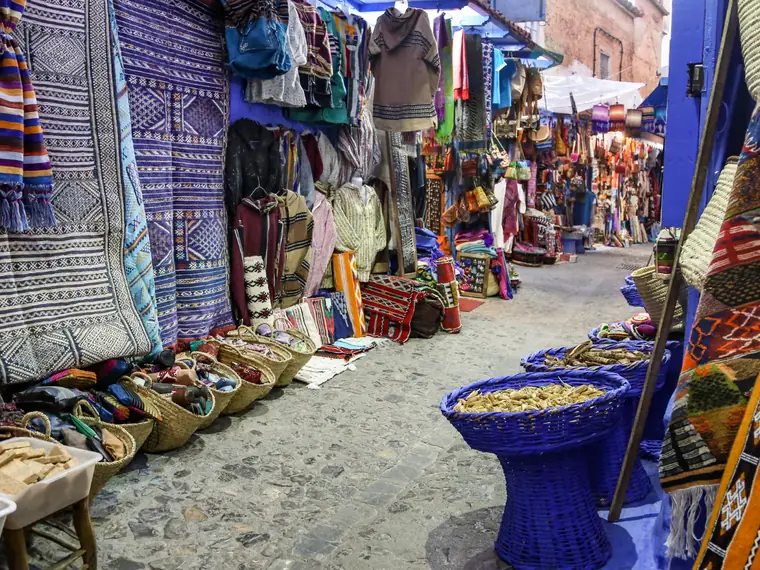
The streets leading down from the square towards the lower gate are the commercial part of the medina, and they are full of colour of a different kind. Shops hang their goods on the blue walls outside: striped blankets in red and white, woollen cloaks, leather bags, carpets, straw hats with coloured pompoms. The displays make strong, graphic pictures, especially where a line of textiles recedes down a lane.
Chefchaouen is a weaving town, and in several workshops men still work wooden looms, throwing the shuttle by hand. Ask politely whether you may watch and take a picture; most weavers agree, and buying a small scarf afterwards is a fair exchange. The interiors are dim, so open your aperture, raise the sensitivity, and use the light from the doorway.
This is the busiest part of town in the middle of the day. Use the crowd rather than fighting it: a slower shutter speed with the camera braced against a wall turns passers-by into soft blurs against sharp blue walls.
06Getting the Blue Right
The colour that brings you here is the one cameras find hardest. There are three common problems, all easy to solve.
The first is white balance. In the shade, and in lanes lit only by light bouncing between blue walls, automatic white balance tends either to exaggerate the blue until skin looks cold and grey, or to “correct” it away so that the walls turn dull. If your camera allows, set the white balance to daylight or cloudy and leave it there, or shoot in a raw format and adjust later. On a phone, tap on a neutral area such as a white wall or grey stone to set the tone.
The second is exposure. A frame filled with pale blue and white will be darkened by the meter; add a little exposure to keep the walls luminous. A frame with deep indigo in shadow may need the opposite. Check your screen and adjust.
The third is temptation. Editing software makes it easy to push saturation until the town looks electric. Resist. The real charm of Chefchaouen’s blue is its variety, chalky, faded, patchy, layered, and heavy editing flattens exactly that. The best pictures look like the place.
07Photographing People, and Being a Good Guest
This matters more than any technical advice. The medina is a residential neighbourhood, and its people live with cameras every day of the year.
- Ask firstFor any picture in which a person is the subject, ask, with a word or a gesture. “Mumkin sura?” means “May I take a photo?” Accept a no with a smile.
- Women and older peopleMany prefer not to be photographed at all, for reasons of modesty and belief. Do not try to steal the shot.
- ChildrenDo not photograph children without a parent’s agreement, and do not give money or sweets for pictures.
- Figures in the distanceA small, unrecognisable figure walking away down a lane is generally accepted. Use judgement, and lower the camera if someone objects.
- Decorated cornersA few residents have arranged a doorway or stairway with pots and props and ask a few dirhams for photographs. Pay cheerfully; they did the work.
- Doorways are homesDo not sit on doorsteps, lean on doors, move objects or block a stairway for a long shoot. Step aside for people carrying loads.
- Keep it quietVoices carry in narrow streets, especially early in the morning.
- Show and shareIf someone agrees to a portrait, show them the result. It often leads to a conversation, and sometimes to a better picture.
08Golden Hour and Blue Hour
From about five in the afternoon the day visitors leave, the sun drops towards the western hills, and warm light begins to reach into the lanes that run east to west. Shafts of sun strike one wall while the opposite one stays in shadow, and where light and shade meet, the blue seems to glow. This is the time for contrast and silhouettes: a figure crossing a patch of sun, a doorway lit like a stage.
About an hour before sunset, leave the medina by the eastern gate, cross the stream at Ras el-Maa, where the washing places and old mills are worth a few frames, and climb the path to the Spanish Mosque. From its terrace you have the whole town opposite you as the light turns gold, then pink.
Do not leave when the sun has gone. The “blue hour” that follows could have been invented for this town. As the sky darkens to cobalt, the lamps come on in the lanes below, and walls and sky become the same colour. Walk back down through the medina in the dusk: under the yellow street lamps, the blue turns violet and the stairways look like stage sets. Brace your camera on a wall or a step, and use a slow shutter.
09Gear and Practical Tips
You need very little:
- One camera, one or two lensesA wide to standard zoom covers the lanes. A fast 35 or 50 mm lens is ideal for dim light and details. Leave the heavy bag in your room.
- A phone is enoughModern phones handle these scenes well. Use the wide lens for stairways and tap to set exposure on the brightest wall.
- No tripod in the lanesIt blocks the way and attracts attention. A small tabletop tripod or a wall will do for dusk.
- Spare battery and cardYou will take more pictures than you expect.
- Shoes with gripPainted steps are slippery, especially when freshly washed or after rain.
- Rain is a giftWet cobbles reflect the blue, colours deepen and the streets empty. Carry a cloth for the lens.
- SeasonsSpring brings fresh paint and flowers; autumn, soft light; winter, mist and empty lanes; summer, long evenings and the most visitors.
- DronesNot permitted in Morocco without prior authorisation.
10Beyond the Postcard
When you have taken the pictures everyone takes, put the camera down for an hour and walk without it. Then pick it up again and look for what is yours alone. Climb to the lanes near Bab el-Ansar and Bab Sebanin, where daily life goes on without an audience. Visit the weekly market in the lower town, when Rif farmers in straw hats and striped cloths bring their produce. Photograph hands kneading dough, a game of cards in a café, the baker at his oven, light falling through a vine.
The blue is the reason people come to Chefchaouen. The people, and the way they have made an ordinary mountain town into something so cared for, are the reason they remember it.
11Chefchaouen Photography: Frequently Asked Questions
What is the best time of day to photograph Chefchaouen?
Early morning, before nine, for empty lanes and soft light, and the hour around sunset for warm light and the view from the Spanish Mosque.
Can I photograph people in Chefchaouen?
Only with permission when they are the subject of the picture. Many residents, especially women, prefer not to be photographed.
Do I have to pay to take photos?
Not in the streets generally. A few specially decorated corners ask a small fee, which is fair to pay.
Is one day enough for photography?
A night in town is far better than a day trip, because the best light is in the early morning and at dusk.
Do I need a professional camera?
No. A phone gives excellent results in Chefchaouen if you pay attention to light and exposure.