
Destinations
The Best Viewpoints in Chefchaouen
- Oct 10, 2026
- 9 min read
- By Magic Morocco Tours
The blue town from above…
Share
Chefchaouen is usually photographed from the inside: a blue stairway, a painted door, a cat on a step. But the town has another beauty that you only discover by stepping back. It sits in a fold of the Rif, pressed against the foot of two great limestone peaks, and from the right place you see the whole of it at once, a spill of blue and white houses under red-tiled roofs, with green hills falling away below. This guide takes you to the best places to see it, from an easy rooftop to a mountain path, and tells you when each is at its finest. These are the Chefchaouen viewpoints we take our own guests to.
01The Lie of the Land
A little geography helps you choose your viewpoints. Chefchaouen is built on a slope facing roughly south-west, at about 600 metres. Behind it, to the north-east, rise the twin summits that gave the town its name, “the horns”, climbing above 2,000 metres. The old medina occupies the upper part of the slope; the modern town spreads out below it.
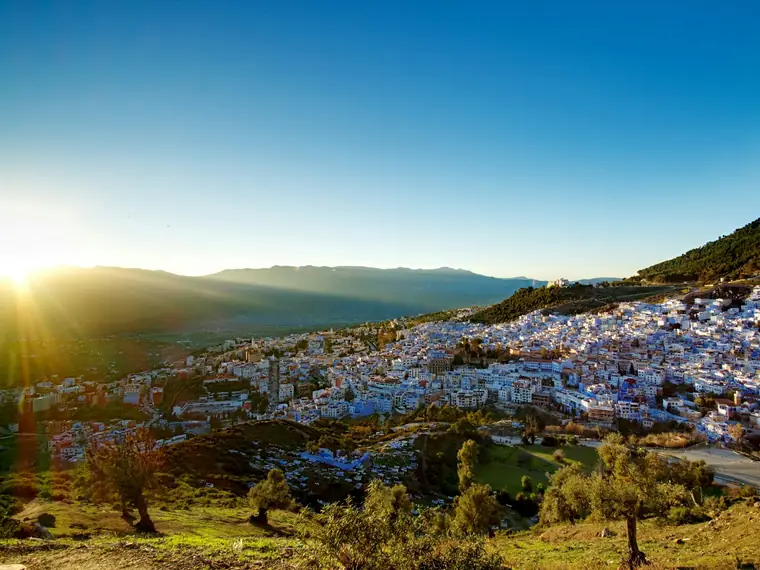
At the top corner of the medina, a spring called Ras el-Maa gushes from the mountain and runs down a small valley along the eastern edge of the town. On the far side of that valley is a hill with a little white mosque on top. Because the town faces west, it is in shadow in the early morning and catches the sun in the afternoon and evening, which is why sunset is the classic time for views. But morning has its own rewards, as you will see.
021. The Spanish Mosque
If you have time for only one viewpoint, this is it. On a hill to the east of the medina stands a small whitewashed mosque with a square minaret, built by the Spanish in the 1920s, during the protectorate, and never used by the townspeople. It was abandoned for decades and has since been restored. The building is closed, but its terrace and the slopes around it face the town across the valley at exactly the right distance and height.
To get there, leave the medina by the eastern gate, Bab el-Ansar, and cross the bridge at Ras el-Maa. A broad stone path climbs from the far bank through prickly pear and olive trees. It takes twenty to twenty-five minutes at an easy pace, with the view opening behind you at every turn.
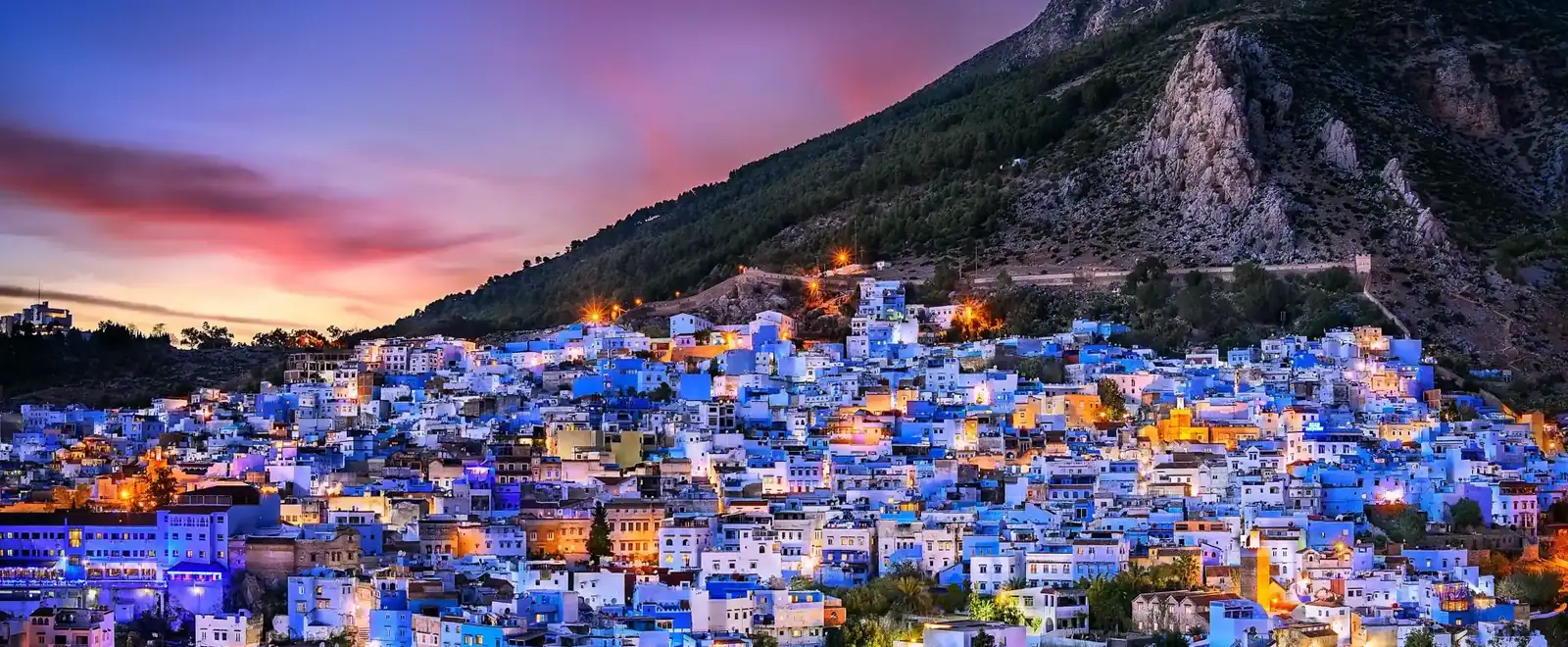
Arrive an hour before sunset and find a place on the wall. In front of you lies the whole medina, hundreds of blue and white cubes stacked up the hillside, with the red tower of the kasbah and the minarets standing out among them. As the sun sinks towards the hills beyond, the blue warms and deepens, lamps begin to appear, and the evening call to prayer rises from five or six mosques at once. Half the visitors in town are there with you, along with local families and sellers of tea and prickly pears. It is sociable rather than solitary, and it is unforgettable.
At sunset from the Spanish Mosque, Chefchaouen looks like something poured down the mountainside.
The classic, for good reason…
03The Same Hill at Sunrise
Few people think of climbing to the Spanish Mosque at dawn, and that is the reason to do it. You will probably be alone. The sun rises behind you, over the mountain, so the town itself stays in soft shadow for the first hour while the hills to the west turn pink and gold. Mist often lies in the valleys below. The colours are cooler and more delicate than in the evening, smoke rises from the bakeries, and the only sounds are cockerels and the stream.
It is not the dramatic picture of sunset, but for atmosphere it is the better visit. Take a torch for the path if you set out in the dark, and a warm layer; mornings are cold at this altitude for much of the year.
042. The Tower of the Kasbah
For a view from the very centre of town, visit the kasbah on the main square, Plaza Uta el-Hammam. This small red fortress was built by the founder of Chefchaouen in the fifteenth century. Inside its walls are a garden of palms, fig trees and flowers, a modest museum and the old prison cells.
A staircase leads up one of the towers to a platform level with the roofs. From here you look straight down on the square with its cafés and its great tree, across to the octagonal minaret of the Grand Mosque next door, and over a sea of tiled roofs to the mountains. Because you are in the middle of the medina rather than outside it, this is the best place to understand how the town is put together. It is also a good choice for anyone who would rather not climb a hill. Go in the late morning or mid-afternoon, when the light is on the roofs.
053. Rooftop Terraces
The easiest viewpoints in Chefchaouen are the ones with a chair and a glass of tea. Almost every guesthouse in the medina has a roof terrace, and many restaurants and cafés do too, particularly around the main square and in the lanes climbing above it.
From a rooftop you see a different town: not the painted lanes but the world above them. Washing lines, satellite dishes, grapevines on trellises, women beating carpets, cats crossing from house to house, and beyond it all the wall of the mountain. In the evening, swifts scream overhead and the sky turns from blue to orange behind the minarets.
When you choose where to stay, ask for a riad in the upper part of the medina with an open terrace facing the mountain or the valley. Breakfast up there, in the first sun, is one of the pleasures of the town. If your guesthouse has no view, the terrace cafés on the square will give you one for the price of a mint tea.
064. Ras el-Maa and Bab el-Ansar
The eastern gate of the medina, Bab el-Ansar, opens on to a scene quite unlike the rest of the town. Just outside, the spring of Ras el-Maa pours out of the rock in a cold, clear torrent and tumbles down between boulders. Stone washing places line the stream, and you will often see women scrubbing clothes and rugs there, as they have for generations. Cafés set tables on platforms above the water.
It is not a panorama, but it is a viewpoint of another kind. Stand on the bridge and look upstream to the mountain and downstream along the outer wall of the medina, with blue houses perched above the gorge and old mills on the banks. From the gate itself, looking back, the upper town rises in tiers. This is also the starting point for the path to the Spanish Mosque, so the two fit together naturally.
075. The Hills Above the Town
The finest views of all are reserved for walkers. Above the medina, tracks climb through pine woods and terraces of olive and fig towards the foot of the cliffs. Within half an hour you are high above the roofs, and the town appears as a small blue patch in a vast landscape of ridges fading into the distance. On a clear day you can see far across the Rif.
One popular route continues beyond the Spanish Mosque along the hillside to a higher shoulder, adding about forty minutes each way. Another climbs from the top of the medina, behind the campsite and the old hotel on the hill, towards the pass between the two peaks. Paths are not always marked, and the mountain is bigger than it looks, so for anything more than a short stroll take a local guide. He will know the way, the shepherds and the best ledge for a picnic.
Longer hikes lead into the Talassemtane National Park, where the views are of forests and gorges rather than of the town.

For those who like to walk…
086. From the Road
Do not put your camera away when you leave. Two of the best general views of Chefchaouen are from the roads that approach it. Arriving from Tetouan and Tangier, the road rounds a bend and the town appears across the valley, spread beneath its two peaks. Arriving from Fes and Ouazzane, you see it from below, climbing the slope.
There are lay-bys where a driver can stop safely, and in the late afternoon the light falls full on the houses. If you are travelling with us, simply say the word and we will pull over.
09A Few Words on Photographing the Views
From the Spanish Mosque, a wide-angle lens takes in the town and its mountain, but a short telephoto is often more satisfying: it lets you pick out the kasbah, a minaret, a cluster of blue roofs or a line of washing, and compress the houses into a pattern. Stay after the sun has set. Ten to twenty minutes later, when the sky is still luminous and the street lamps have come on, the blue of the walls and the warm points of light balance perfectly.
On hazy summer days the distance turns flat and pale; early morning is then the better choice. After rain the air is transparent and the colours are at their strongest. And if cloud drops over the peaks, do not give up: mist drifting across the upper town can produce the most atmospheric pictures of all.
10When to Go Where
Matching the place to the hour makes all the difference.
- SunriseSpanish Mosque hill for solitude, mist and soft colour
- MorningRooftop breakfast; Ras el-Maa while the washing places are busy
- MiddayThe kasbah tower, with the sun on the roofs
- SunsetSpanish Mosque terrace, or a rooftop on the square
11Practical Tips
To enjoy the views in comfort:
- FootwearPaths are stony and the medina steps can be slippery. Wear shoes with a good grip.
- Water and a hatThere is little shade on the hill to the Spanish Mosque. In summer, go late.
- A warm layerIt cools quickly after sunset, and in winter the wind on the hill is sharp.
- A torchUseful for walking down after dark or up before dawn, although the main path is easy.
- WeatherThe Rif is the wettest part of Morocco. Cloud can hide the peaks, especially from November to March; if the morning is clear, do not wait for the afternoon.
- RespectViewpoints overlook homes and terraces. Use a long lens thoughtfully, and ask before photographing people.
- DronesDrones cannot be brought into Morocco without authorisation.
12Chefchaouen Viewpoints: Frequently Asked Questions
What is the best viewpoint in Chefchaouen?
The terrace of the Spanish Mosque, on the hill east of the medina, gives the classic view over the whole town.
How long is the walk to the Spanish Mosque?
About twenty to twenty-five minutes uphill from the Ras el-Maa spring, on a clear stone path.
Is sunrise or sunset better?
Sunset has warmer light on the town and a lively atmosphere. Sunrise is quieter, with softer colours and often mist in the valleys.
Can I get a good view without hiking?
Yes. The kasbah tower and many rooftop terraces in the medina offer fine views with little effort.
Do I need a guide for the hills?
Not for the Spanish Mosque. For longer walks above the town, a local guide is recommended.
About the Author

We travel these roads all year and love sharing real stories, hidden gems and practical advice with you.

Visit Chefchaouen on a Private Tour
- Private vehicle and driver
- Time for the Spanish Mosque at sunset
- Stay in the blue medina
- From Tangier or Fes
Related Articles
Explore more
Continue Your Journey
Turn what you have read into a real itinerary. Our local team will shape a private route around your dates, your interests and your pace.


Planning your trip? For official information about Morocco, visit Visit Morocco, the website of the Moroccan National Tourist Office.