
Beyond the dunes of Erg Chebbi, where the sand gives way to black stone plains, you will sometimes see a low dark tent, a few goats, a line of washing and a thread of smoke. A family lives there. They are among the last nomads of the Moroccan Sahara, people who still move with their animals according to pasture and water. A visit to one of these families, over a glass of tea, is often the moment travellers remember long after the camel ride. This article explains who they are, how they live, and how to be a good guest. Here is what life is like for the Sahara nomads of Morocco today.
01Who Are the Nomads?
The nomads of south-eastern Morocco are Amazigh, the indigenous people of North Africa, often called Berbers by outsiders. Around Merzouga and the Saghro most belong to the great confederation of the Aït Atta, and in particular to its eastern branch, the Aït Khebbach. Their language is Tamazight, with Arabic as a second language.
For centuries these tribes controlled the routes between the Atlas and the Sahara. They guided and protected the caravans that carried salt, gold, cloth and dates between Timbuktu and the markets of Sijilmassa, near today’s Rissani, and they raised camels, sheep and goats on pastures that no farmer could use. Their knowledge of wells, stars and weather was their wealth.
The twentieth century changed that world. Borders were closed, lorries replaced caravans, and long droughts reduced the herds. Most families settled in villages such as Merzouga, Hassilabied, Taouz and Khamlia. Many of the people you meet working in desert camps, leading camels or driving 4x4s were born under a tent, or their parents were. A much smaller number still live as their grandparents did, and it is these families you may visit.
02The Tent: A House That Can Be Folded
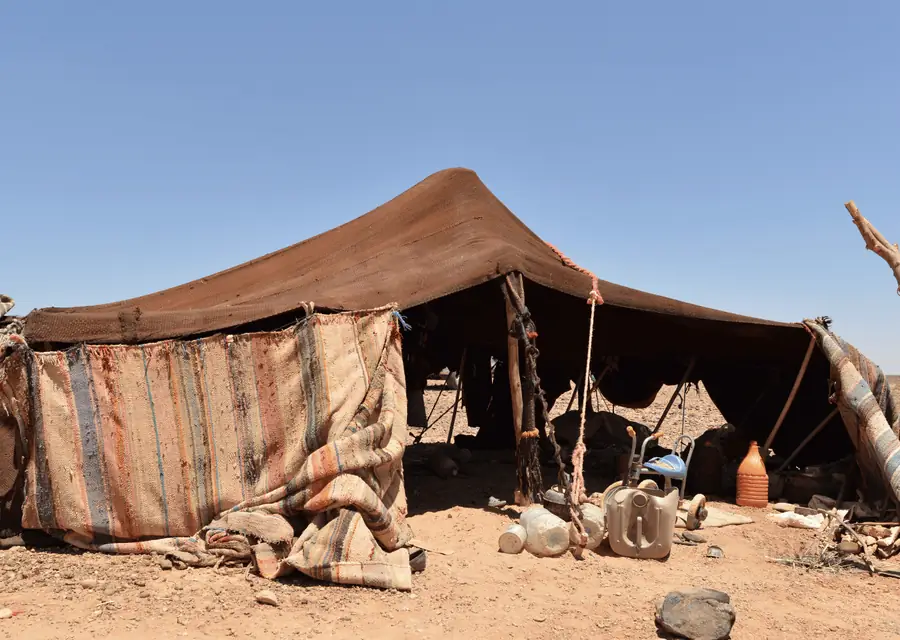
The nomad tent is called a khaima. Its roof is made of long strips woven from goat hair and sheep’s wool, sewn edge to edge and stretched over wooden poles. The dark wool gives deep shade; its fibres swell when wet, so the tent sheds rain; and in the heat, the loose weave lets air through. Weaving the strips is the work of the women, on a ground loom pegged out in the sand, and a tent is renewed strip by strip over many years.
Inside, space is organised simply. One side is for receiving guests, with carpets and cushions. The other is the family’s, with bedding rolled up by day, sacks of flour and sugar, and the kitchen things. Cooking is often done in a separate shelter of reeds or stone, so that smoke stays out of the tent. Nearby stand a pen of thorn branches for the young animals, a clay bread oven, and perhaps a small solar panel to charge a telephone and power a lamp.
Everything can be loaded on to camels or a pick-up in a morning. In winter the tent is pitched in a sheltered hollow facing away from the wind; in summer on higher, more open ground, or the family moves towards the mountains.
A tent is not a poor house. It is a house designed to move, and everything in it has a reason.

03A Day in the Life
Morning
The day begins before sunrise. The fire is revived, tea is made, and the goats are milked. Bread dough, mixed the night before, is baked in the clay oven or directly under hot sand and embers. After breakfast the flock is let out. Herding is often the work of the older children or of a shepherd, who will walk many kilometres with the animals in search of the sparse grasses and acacia that follow a little rain.
Midday
Water governs everything. It is fetched from a well, sometimes several kilometres away, in jerrycans carried by a donkey. Women prepare the main meal, look after the smallest children, churn milk into butter by rocking a goatskin, spin wool and weave. In the heat of the afternoon everyone rests in the shade.
Evening
The animals return at dusk and are counted in. The evening meal is simple: a tagine of vegetables with a little meat, or couscous, or bread with oil and dates. Then the fire, more tea, and talk. Without electric light the night comes quickly, and the sky above is the same one the caravan guides once read to find their way.
04Tea and the Law of Hospitality
In the desert a stranger who arrives at a tent is offered tea before any question is asked. Hospitality is not politeness here; it was a matter of survival, and it remains a point of honour. Whatever the family has is shared.
Tea is prepared by the head of the family or an honoured guest, slowly, in front of everyone. Green tea is rinsed, boiled in a small enamel pot on the embers with a block of sugar, then poured back and forth between pot and glass to mix it and raise a foam. It is served in small glasses, traditionally three in succession. A saying known all over the Sahara describes them: the first glass is bitter like life, the second strong like love, the third gentle like death. Mint is added when there is some; in the deep desert there are often wild herbs instead.
With the tea may come bread still warm from the sand, olive oil, dates or peanuts. Take a little of what is offered, even if you are not hungry. Refusing everything is the only real way to be impolite.
05The Skills of the Desert
To an outsider the desert looks empty. To a nomad it is full of information. The colour of the ground shows where water lies close to the surface. Tracks in the sand say which animal passed and when. A change in the wind announces a sandstorm an hour before it arrives. Plants that seem dead are known as fodder, medicine, soap or firewood.
The dromedary is at the centre of this knowledge. It can go many days without drinking, carry heavy loads and walk on soft sand where no other animal could. It provides milk, wool and, on great occasions, meat. A good herder recognises each of his camels by its footprint.
Crafts are equally practical. Women weave tent cloth, blankets and carpets whose diamond and zigzag motifs are handed down from mother to daughter and vary from tribe to tribe. Men work leather, braid ropes from palm fibre and repair almost anything with almost nothing. Nothing is thrown away.
06A Changing World
It would be wrong to present the nomads as people outside time. They use mobile phones and solar panels, sell animals at the souk of Rissani, and take the sick to the hospital in Erfoud. Their life is hard, and its difficulties are real: years without rain, long distances to water, and above all the question of school. Children who follow the flock cannot attend class, and many families settle for that reason alone, or leave the children with relatives in a village.
Tourism has become part of the answer. A family that receives visitors, sells a carpet or hires out camels earns an income that helps it stay in the desert if it wishes to. Others have chosen a semi-nomadic life, with a house in the village and a tent on the pasture for part of the year.
There is no need to be sad about this, or to romanticise what came before. What deserves respect is the skill and dignity with which people continue to make a life in one of the most demanding landscapes on earth.
07How to Visit with Respect
A visit to a nomad family is a visit to a private home. A few simple courtesies matter:
- Go with a local guideYour driver-guide knows the families and speaks their language. He will introduce you, translate, and make sure the visit is welcome that day.
- Remove your shoesLeave them at the edge of the carpets before you sit down.
- Ask before taking photographsMany women prefer not to be photographed. Always ask, accept a refusal with a smile, and show people the pictures you take.
- Accept the teaDrink at least one glass and take your time. A visit that lasts ten minutes is not a visit.
- Give thoughtfullyRather than sweets or money for children, bring something useful for the household, such as tea, sugar, oil or flour, or school supplies, and give it to the parents. Your guide can advise and stop at a shop on the way.
- Dress modestlyCover shoulders and knees, as you would in any rural home in Morocco.
- Buy if you wish, without pressureIf the family has weaving for sale and you like it, buying directly is the best support there is. If not, a sincere thank-you is enough.
08Beyond the Tent: Khamlia and Rissani
Two other visits complete the picture of life on the edge of the dunes. In the village of Khamlia, south of Merzouga, live the descendants of people brought across the Sahara from West Africa centuries ago. They have kept their own music, Gnawa, played on drums, a three-stringed lute and iron castanets, and they perform it for visitors in a simple room over a glass of tea. It is rhythmic, hypnotic and quite unlike anything else you will hear in Morocco.
In Rissani, the market held on Sundays, Tuesdays and Thursdays is where the nomads and the villagers of the whole region meet. There is an enclosure for sheep and goats, another for donkeys, stalls of dates, spices and cloth, and blacksmiths working in the open. Together with a nomad family, the two visits fill a wonderful day by 4x4 around the dunes.
09The Seasons of Movement
Nomadism is not wandering. It is a planned movement between known places, repeated year after year. In the south-east the classic pattern runs between the desert and the mountains. Winter is spent on the low plains around the dunes and in the Saghro, where the days are mild and a little rain brings up grass. As the heat rises in late spring, families who still make the long journey lead their flocks north, up through the valleys of the Dades and the Todra, to the high pastures of the Atlas, and come down again in autumn before the snow.
The routes, the wells and the grazing rights along the way are agreed between tribes and have been for generations. Today part of the journey is often made by lorry, and many families move only short distances. But the calendar of the herd, lambing in winter, shearing in spring, selling before the feast, still sets the rhythm of the year.
10Sahara Nomads: Frequently Asked Questions
Are there still nomads in Morocco?
Yes, though far fewer than in the past. Some families still live under tents with their herds around Merzouga, in the Saghro and on the high pastures of the Atlas, while many others have settled in villages.
Can I visit a nomad family near Merzouga?
Yes. It is usually part of a 4x4 excursion around Erg Chebbi, or it can be arranged on request on a private tour.
What should I bring as a gift?
Practical things are best: tea, sugar, cooking oil, flour or school supplies, given to the parents. Your guide can help you choose.
What language do the nomads speak?
Tamazight, the Amazigh language, and usually Moroccan Arabic. Your guide will translate.