
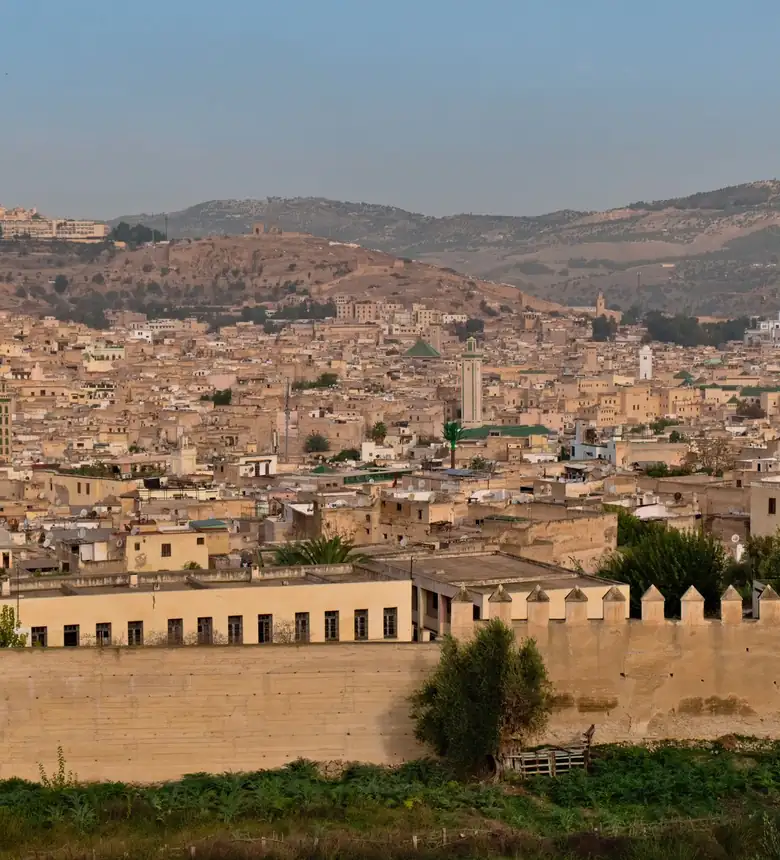
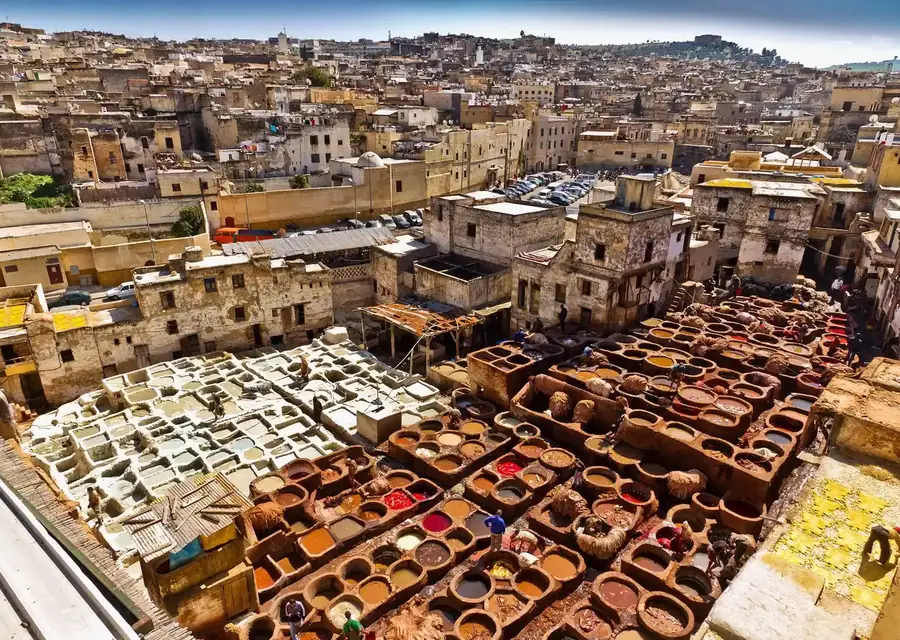
Deep in the medina of Fes, hidden behind a ring of tall houses, lies a courtyard that looks like a giant paintbox. Hundreds of round stone vats, some white as milk, others brown, red, ochre and yellow, are packed together like the cells of a honeycomb. Men stand in them up to their thighs, lifting and treading heavy wet skins. This is the Chouara tannery, the largest and oldest of the three that survive in the city, and one of the last places in the world where leather is still made almost entirely by hand. This article explains what you are looking at. The Fes tanneries are among the most extraordinary sights in Morocco.
01A Thousand-Year-Old Trade
Tanning is among the oldest industries of Fes. Chroniclers of the Middle Ages counted dozens of tanneries in the city, and tradition holds that leather has been worked on the site of Chouara since the early centuries after the city’s foundation, more than a thousand years ago. The location was no accident. A tannery needs a great deal of water, and the river that runs through the bottom of the medina provided it, as well as carrying the waste away downstream.
The leather of Morocco was famous throughout the medieval world. Fine goatskin, tanned with sumac and dyed in brilliant colours, was exported to Europe, where it was prized for binding books. The English word “morocco”, for a soft, grained leather, and the French “maroquinerie”, meaning leather goods, both come from the name of the country.
Three tanneries remain in Fes today: Chouara, by far the largest; Sidi Moussa, to the west; and Aïn Azliten, on the edge of the medina. Chouara was thoroughly restored in 2015 and 2016, when its vats, channels and surrounding buildings were repaired, but the methods were left as they were.
02The Guild of Tanners
The tanners form one of the oldest guilds in the city, with their own patron saint and a strong sense of identity. The work is hard and has always been respected for that reason: an old saying of Fes calls the tannery “the house of gold”, because of the wealth that leather brought to the city.
The trade is hereditary. The right to work a set of vats passes from father to son, and many of the men you see below can name grandfathers and great-grandfathers who stood in the same pits. They work as a cooperative of independent craftsmen rather than as employees. Each master tanner buys his own skins, processes them with the help of his sons or apprentices and sells the finished leather to the makers of bags, slippers and jackets in the surrounding souks.
Within the tannery, tasks are divided. Some men specialise in the first cleaning, others in dyeing, scraping or softening. Boys begin by carrying skins and learn each stage over years.
03From Raw Hide to Leather, Step by Step
The whole process takes around three to four weeks. From the terraces you can see almost every stage happening at once.
- 1. The skins arriveRaw hides of sheep, goat, cow and camel are brought from slaughterhouses and country markets on the backs of mules and donkeys, the only transport that fits the lanes. They are sorted by type and quality.
- 2. The white vatsSkins are soaked for several days in the pale pits, which hold a mixture of water, quicklime, salt and, traditionally, cow urine. This loosens the hair and the remaining flesh and begins to break down the fibres.
- 3. ScrapingThe skins are hauled out, and the hair and fat are scraped off by hand with a curved knife over a wooden beam. The wool is kept and sold.
- 4. The pigeon vatsNext comes a bath of water and pigeon droppings, collected from dovecotes around the region. The droppings contain ammonia, which softens the skin and prepares it to absorb dye. The tanners knead the hides with their bare feet for hours. This stage produces the famous smell.
- 5. WashingThe skins are rinsed thoroughly, in the past in the river and today in large wooden drums turned like waterwheels.
- 6. Tanning and dyeingThe clean skins go into the coloured vats, where vegetable tannins and dyes penetrate them over several days. Again they are trodden and turned by men standing in the liquid.
- 7. DryingThe dyed hides are carried up to the roofs and out to the hillsides around the medina and spread in the sun. Whole terraces turn yellow or red.
- 8. FinishingDry leather is stiff. It is stretched, scraped thin on the flesh side with a sharp blade, softened by hand and trimmed. Only then is it sold to the leatherworkers.
04The Colours and Where They Come From
The beauty of the tannery lies in its colours, and traditionally every one of them came from a plant or a mineral. Brown comes from the bark of the mimosa tree and from cedar wood. Red comes from poppy flowers and from paprika. Orange is given by henna, blue by indigo, green by wild mint, and black by a mixture containing iron.
The most precious colour is yellow. It is the colour of the classic Fes slipper, and at its finest it is made with saffron, the costliest spice in the world, or with pomegranate rind. Because the dye is so valuable, yellow is not applied in the vats at all but rubbed on to each skin by hand, and yellow hides are dried apart from the others.
Natural dyes give leather a depth and slight irregularity that synthetic colours do not, and they age well. It should be said that chemical dyes are now also used in Fes for part of the production, as they are cheaper and faster. If the method matters to you, ask the seller how a piece was coloured; a good one will explain honestly.
Poppy, henna, indigo, mint and saffron: the tanner’s palette is a herbalist’s shelf.
05About the Smell
Every account of the tanneries mentions it, and rightly. The combination of raw hides, lime and fermenting pigeon droppings is powerful, particularly on a hot afternoon in summer. It is the smell of a medieval city at work, and it is part of the experience.
As you climb to the terraces, you will be handed a sprig of fresh mint to hold under your nose, which helps a great deal. The smell is much milder in the cooler months and in the morning. After ten minutes most people stop noticing it, absorbed by what is happening below. If you are particularly sensitive, stand on an upper terrace where the air moves, or keep the visit short.
06How to Visit
You cannot walk among the vats; the tannery is a workplace, the stone is slippery and the pits are deep. Instead you look down on it from the balconies of the leather shops that surround it on all sides. The entrances are in the lanes of the Blida quarter, north-east of the Qarawiyyin, and each is numbered. You climb several flights of narrow stairs through showrooms hung with bags and jackets and come out on a terrace with the whole courtyard at your feet.
There is no ticket. The arrangement is that the shop gives you access and an explanation, and hopes you will look at its goods on the way down. You are under no obligation to buy. If someone has guided you and explained the process, a tip of a few dirhams is customary and appreciated.
Go in the morning, ideally between nine and noon, when the largest number of men are at work and the sun lights the vats. On Fridays activity is much reduced. It is easiest to visit with your city guide, who will take you to a reliable terrace and spare you the young men in the lanes offering to lead you to “the best view”.

07Buying Leather in Fes
If you would like to take something home, the shops around the tannery offer an enormous choice. Some advice:
- Know the skinsGoat is fine, light and strong, used for bags and slippers. Sheep is soft and good for jackets. Cow is thick and hard-wearing, for belts and luggage. Camel is tough and used for bags and poufs.
- Check the makingLook at the stitching, the lining, the zips and the edges. A well-made bag is sewn, not simply glued.
- Feel and smellGood leather is supple and smells of leather. A faint tannery odour fades with airing; a harsh chemical smell is a poor sign.
- BabouchesThe traditional slipper of Fes is pointed, with a soft sole, and the heel is worn folded down. Yellow is the classic colour for men.
- PoufsSold flat and unstuffed, they pack easily. Fill them at home with old clothes or textile filling.
- Bargain calmlyPrices are negotiable. Compare two or three shops, decide what the piece is worth to you and take your time.
- Made to measureSome workshops will make a jacket or adjust a bag strap in a day or two. Allow time before you leave Fes.
08A Hard Trade, and Its Future
It is impossible to watch the tanners for long without thinking about the labour involved. They stand for hours in cold liquid in winter and under a fierce sun in summer, lifting skins that weigh far more wet than dry. The lime is harsh on the skin, and the work is hard on the back and the joints. Younger men increasingly look for other jobs, and the number of tanners is smaller than it once was.
At the same time, the tannery is a source of pride and one of the reasons travellers come to Fes. The restoration of Chouara improved working conditions, drainage and the stability of the surrounding buildings, and efforts have been made to reduce pollution of the river. Visitors play their part by treating the men below with respect, as craftsmen rather than as a spectacle, and by buying, if they buy, things that were really made here.
What you see from the terrace is rare: not a reconstruction, not a demonstration, but an industry that has run without interruption since the Middle Ages.
09The Other Tanneries of Morocco
Fes is not the only city with tanneries. In Marrakech, those of Bab Debbagh, on the eastern side of the medina, work in a similar way on a smaller scale. Tetouan, in the north, has an old tannery beside its walls, and Taroudant, in the south, is known for its leather sandals. But nowhere else is the setting so dramatic, the scale so large or the tradition so unbroken as at Chouara.
10Fes Tanneries: Frequently Asked Questions
How old is the Chouara tannery?
Tradition dates it back about a thousand years. It was restored in 2015 and 2016, but the vats and methods are those of the medieval tannery.
Does it cost anything to visit the tannery?
There is no entrance fee. You view it from the terraces of the leather shops, and a small tip for the person who shows you around is customary.
Why does the tannery smell?
Because of the raw hides and the baths of lime and pigeon droppings used to soften them. A sprig of mint, offered at the door, helps.
What is the best time to visit?
In the morning, when most tanners are working and the light is best. Avoid Fridays, when there is little activity.
Are the dyes natural?
Traditionally yes: poppy, henna, indigo, mint, saffron and tree barks. Synthetic dyes are also used today for part of the production.
