
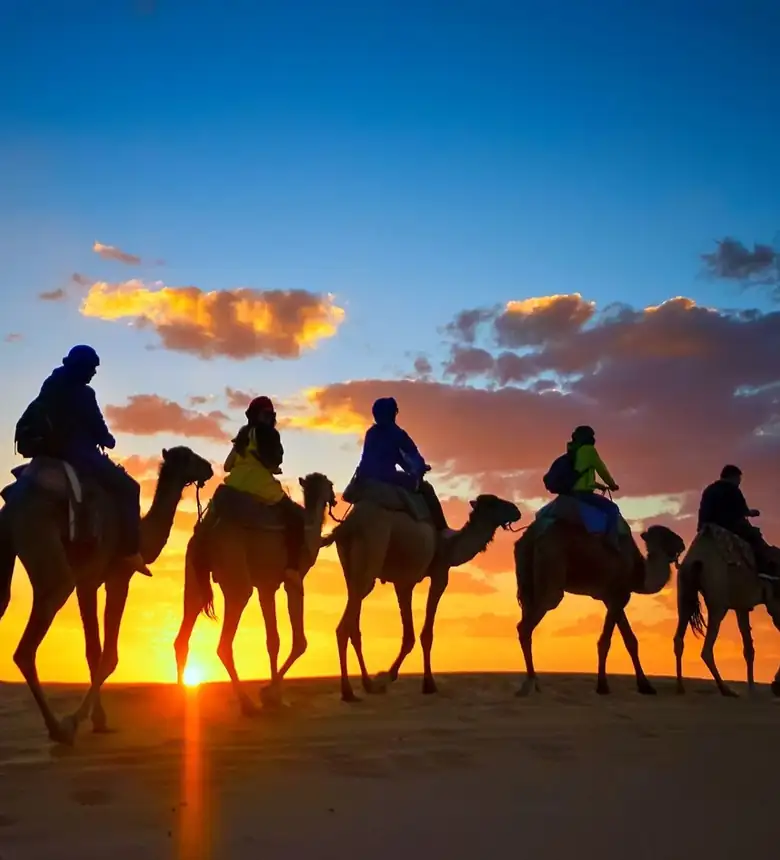
For most travellers, riding a camel into the Sahara is the picture they had in mind when they booked a trip to Morocco. It is also something almost none of them have done before, so it comes with questions. Is it comfortable? Is it difficult? How long does it take? What happens if I do not like it? This article describes a camel trek in Merzouga exactly as it unfolds, from the moment you meet your animal to the moment you slide off at camp, so that you know what to expect and can simply enjoy it.
01The Setting: Erg Chebbi
Merzouga is a village in the far south-east of Morocco, close to the Algerian border, at the foot of a sea of sand called Erg Chebbi. An erg is a field of wind-blown dunes. This one is about twenty-eight kilometres long and five to seven wide, and its highest crests rise around 150 metres above the stony plain. The sand is fine and orange, turning pink at dawn and deep red at dusk.
The dunes begin abruptly. One moment you are on flat black gravel beside the last houses, the next you are walking uphill on soft sand. The camps where travellers spend the night lie inside the erg, hidden in hollows between the dunes, and the traditional way to reach them is on the back of a camel.
02Meet Your Camel
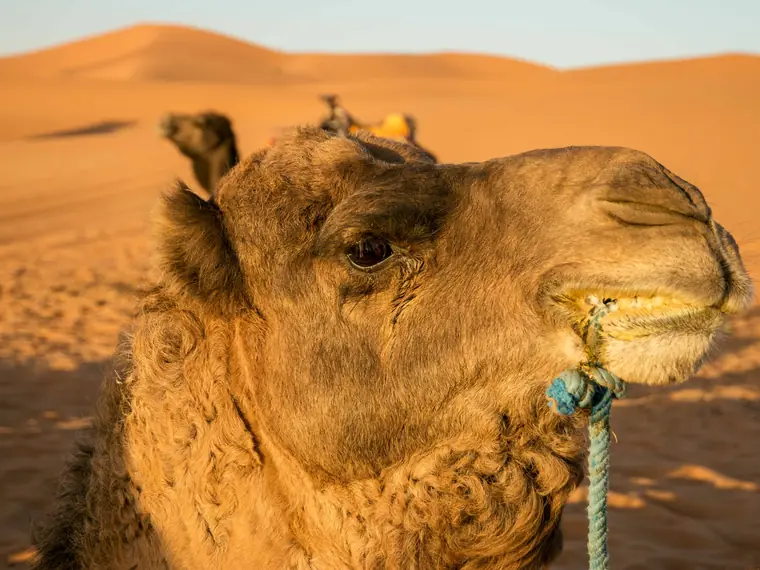
Strictly speaking, the animals of the Sahara are dromedaries, with a single hump; the two-humped Bactrian camel lives in Central Asia. Everyone calls them camels all the same. They are extraordinary creatures. A dromedary can go for days without drinking and then take in a hundred litres in a few minutes. Its hump stores fat, not water. Wide, padded feet spread on the sand like snowshoes, a double row of long eyelashes keeps out the grit, and it can close its nostrils against a sandstorm.
Those used for trekking are almost always males, calm and well accustomed to people. Each has a name and a character, and the men who lead them know them individually. They are tied in a line of four to six, nose to tail, and are led on foot by a camel man who walks at the head of the caravan the entire way. You do not steer; you simply sit and look.
They may grumble loudly when asked to kneel or stand. This is not distress. It is how camels comment on most things, and it usually ends as soon as they are walking.
03Getting On, and the Famous Lurch
The saddle is a metal or wooden frame fitted around the hump, padded with thick folded blankets and fitted with a T-shaped handle at the front. You mount while the camel is kneeling on the ground: swing one leg over, sit down in the middle of the blankets, and take hold of the handle with both hands.
Then comes the only moment that needs attention. A camel stands up in two movements. First it straightens its back legs, which tips you sharply forward; then its front legs, which throws you back level. The trick is simple: when the camel man says so, lean well back and hold on. Two seconds later you are sitting two metres above the ground with a splendid view, usually laughing. Getting off is the same in reverse: lean back as the front legs fold.
Your small bag is tied to the saddle or carried on another animal. Keep your camera or phone on a strap around your neck or wrist rather than in your hand during the standing and kneeling.
04The Ride into the Dunes
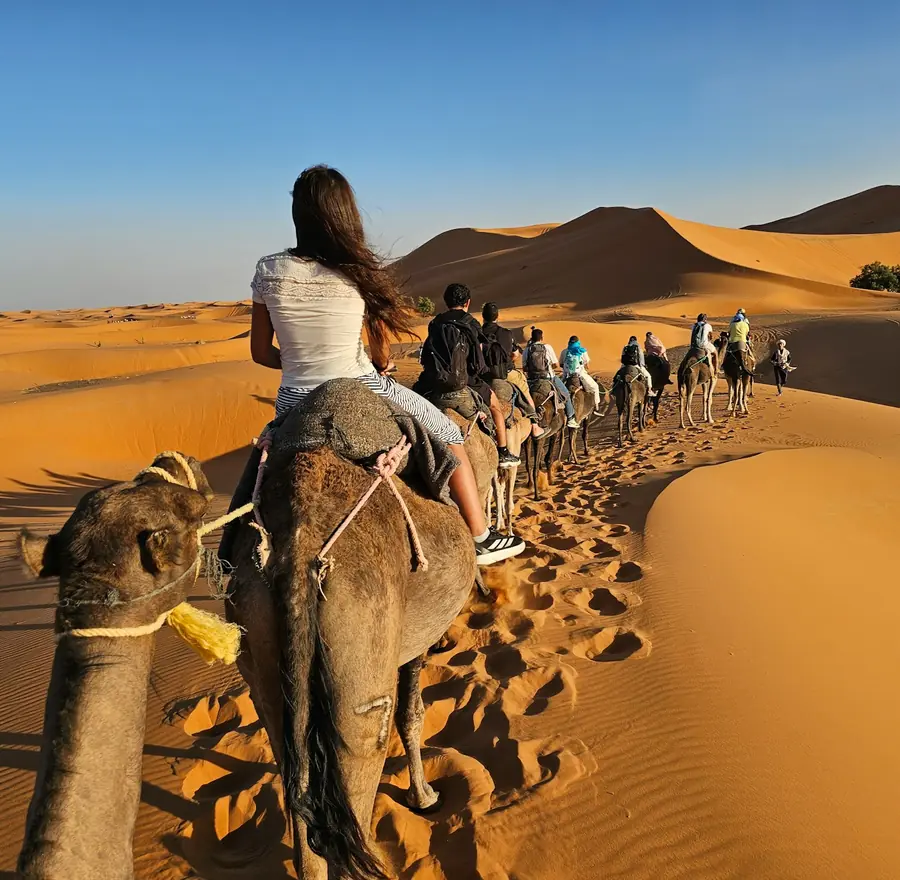
The caravan sets off in single file, usually around an hour and a half before sunset. A camel walks at about four kilometres an hour, with a slow rolling gait that sways you gently from side to side and forward and back. Relax your hips and let your body follow the movement, as you would on a boat, and it soon feels natural.
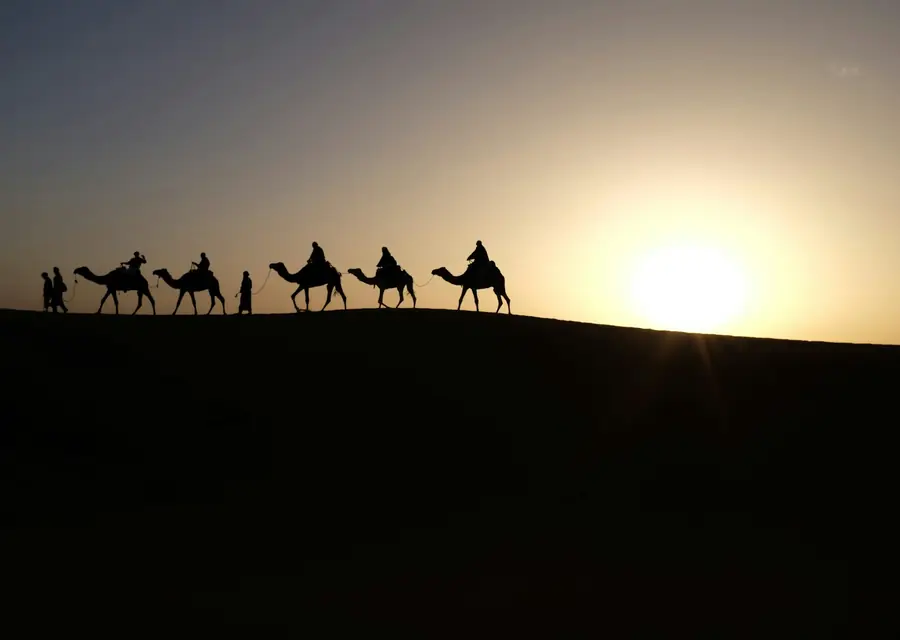
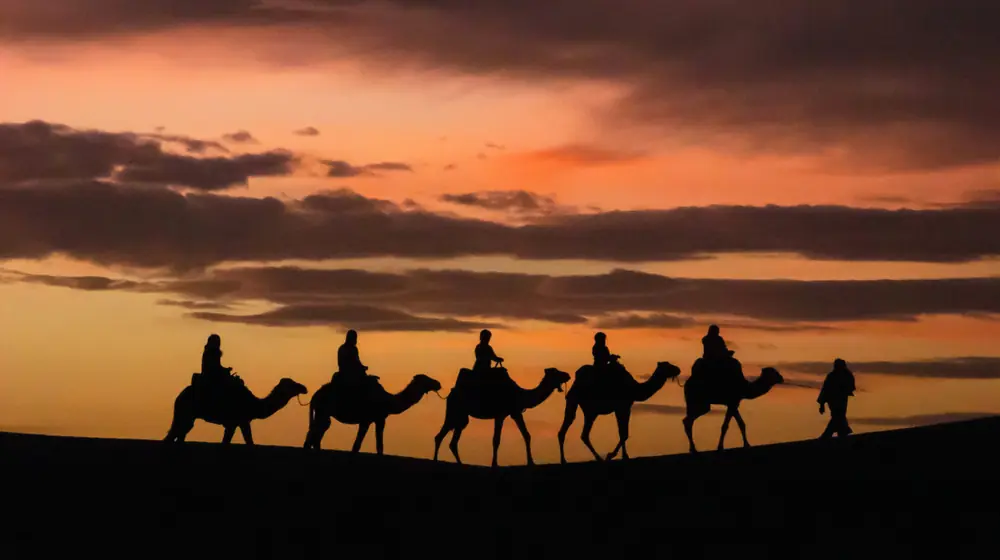
Within ten minutes the village has disappeared behind the first dunes and there is nothing in sight but sand and sky. This is when most people fall silent. There is no engine, no road, only the soft sound of the camels’ feet and the occasional word from the guide. The caravan winds along the ridges and through the hollows, and the long shadows of camels and riders slide across the slopes beside you: the photograph everyone wants.
The ride to a camp takes about an hour to an hour and a half, depending on where it is. That is long enough to feel that you have travelled, and short enough to be comfortable for people who have never ridden. The camel man will stop if you want to adjust your seat or take a picture, and he is very good at taking photographs of you with your own phone.
The desert is best met slowly. At a camel’s pace you notice how the colours change every few minutes.
05Sunset on the Dune
Before reaching camp the caravan halts at the foot of a high dune. The camels kneel and rest while you climb to the crest on foot. Climbing soft sand is harder than it looks: go barefoot, follow the ridge line where the sand is firmest, and take it steadily.
From the top, the erg spreads out in every direction like a frozen ocean. As the sun drops, the dunes pass from gold to orange to rose, the shadows on their eastern faces turn violet, and the wind falls. Guides often bring a sandboard, and sliding down the slope is a favourite of children and adults alike. When the light has gone, you walk or ride the last few minutes to the camp, where tea is waiting.
06Is It Comfortable? An Honest Answer
For an hour or so, yes, for almost everyone. A camel saddle is wider than a horse’s, and after a long ride some people feel it in the inner thighs or the lower back the next day, in the way you might after cycling for the first time in years. A few simple things make a real difference.
Wear long, soft trousers without thick inner seams; shorts are a mistake. Sit upright in the middle of the saddle rather than slumping, and let your legs hang loosely or cross one in front of you on the animal’s neck as the camel men do. Going downhill, lean back and hold the handle; going uphill, lean slightly forward. If something is uncomfortable, say so at once: a folded blanket moved a few centimetres usually solves it.
The return ride in the morning follows the sunrise and feels shorter. If you would rather not ride twice, a 4x4 can bring you back, and many travellers choose the camel in the evening and the vehicle in the morning.
07Who Can Ride, and the Alternatives
A camel trek suits most travellers, with a few sensible exceptions.
- ChildrenChildren generally love it. Small children share a camel with a parent, sitting in front; older children ride their own, led in the same line.
- Older travellersAge is not a barrier if you are comfortable sitting astride and can hold on while the camel stands. Many guests in their seventies ride without difficulty.
- PregnancyRiding is not recommended during pregnancy because of the jolt when the camel rises and kneels. Travel to camp by 4x4 instead.
- Back, hip or knee problemsIf you have a recent injury or a serious condition, choose the 4x4 transfer. You can still sit on a kneeling camel for a photograph.
- Fear of heights or animalsTry a ten-minute ride near the camp first. The animals are placid, and you can dismount whenever you wish.
- The 4x4 optionAny member of a group can go to the same camp by vehicle and meet the riders for sunset. Nobody misses the evening.
08A Word on the Welfare of the Camels
Travellers increasingly ask how the animals are treated, and it is right to ask. Camels are the livelihood of many families around Merzouga, and a healthy, well-fed animal is valuable; most owners look after theirs with care. They work for an hour or two in the evening and again in the morning, carry one rider each, and rest and graze in between.
You can judge for yourself. A camel in good condition has a firm, upright hump, a clean coat without sores under the saddle, and a calm manner. The line should move at a walk, never forced, and the animals should have shade, food and water at their resting place. We work with camel men we know, and we would rather you told us if you ever saw something that troubled you.
Small gestures help too. Mount and dismount when asked, do not pull at the animal or shout near it, and thank the man who walked beside you through the sand for an hour. A tip for him at the end is customary and well earned.
09What to Wear and Bring
For the ride itself you need very little:
- Long trousersSoft, loose and full length.
- A headscarfProtects from sun and wind-blown sand. Your guide will tie it for you in the desert style.
- Sunglasses and sunscreenThe light is strong and reflects off the sand.
- A warm layerThe temperature drops as soon as the sun sets, especially from October to April.
- Closed shoes or sandalsEither will do for riding. Most people climb the dune barefoot.
- WaterA small bottle within reach.
- Camera with a strapAnd a zipped bag to protect it from sand when you are not using it.
10Sunset, Sunrise and the Seasons
Treks are timed around the light, and the hour shifts with the season. An overnight stay includes both a sunset and a sunrise ride.
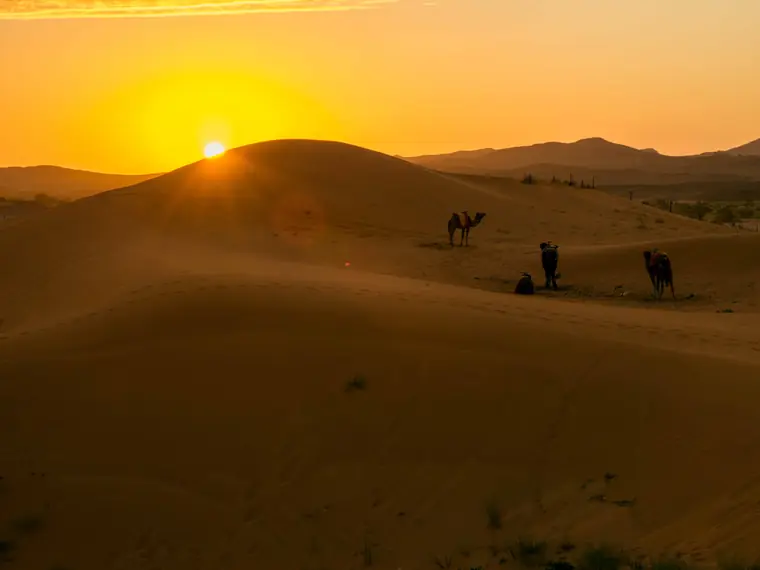 Sunset trek (Evening)Warm colours, long shadows and arrival at camp for dinner.
 Sunrise trek (Morning)Cool, still air, soft pink light and footprints of the night’s animals.
 Oct – Apr (Best season)Comfortable days for riding; cold nights in midwinter.
 Jun – Aug (Very hot)Rides are kept short and close to sunset and sunrise.
11Camel Trek in Merzouga: Frequently Asked Questions
How long is the camel ride in Merzouga?
About an hour to an hour and a half each way to an overnight camp. Shorter rides at sunset or sunrise can also be arranged.
Is riding a camel difficult?
No. The camels are led on foot by an experienced camel man, and you only need to hold on while the animal stands up and kneels.
Does camel riding hurt?
Not for a ride of this length, if you wear long trousers and sit relaxed. Some people feel mild stiffness in the legs the next day.
Is there a weight limit?
A dromedary carries an adult rider comfortably. If you have concerns, tell us in advance so the camel men can choose a suitable animal.
Can I go to the camp without riding?
Yes. A 4x4 transfer to the same camp is always available.
