
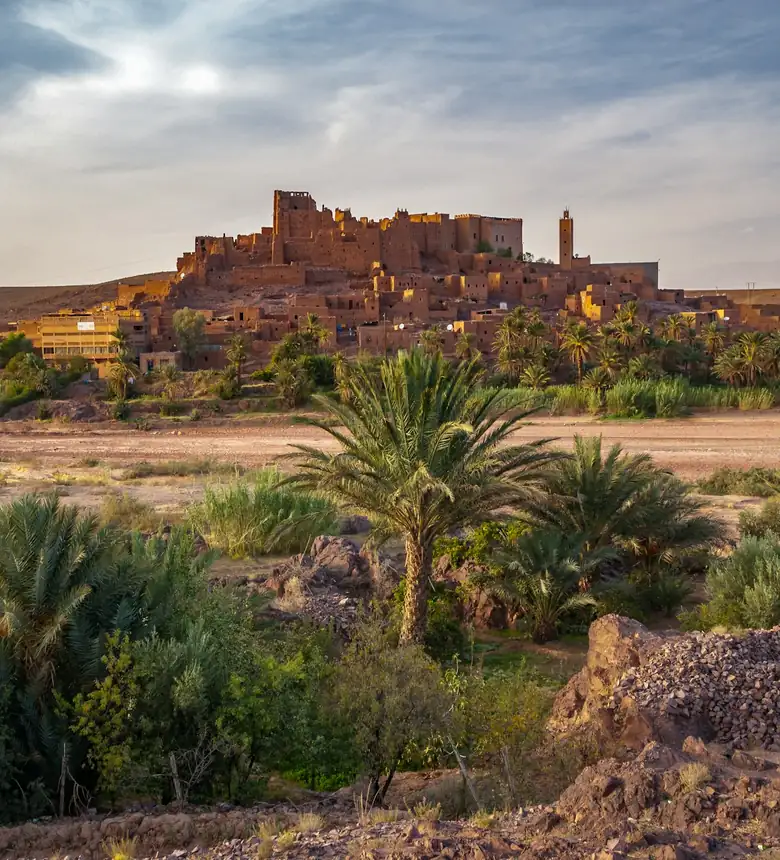
East of Ouarzazate, a road runs for about 170 kilometres along a broad valley between two mountain ranges, the High Atlas to the north and the dark ridges of the Saghro to the south. Wherever a river comes down from the snows, there is an oasis, and in every oasis stand fortified houses of red earth, their towers decorated with patterns in mud brick. There are so many that travellers long ago gave the route a name: the Road of a Thousand Kasbahs. Nobody has counted them. But the name captures the feeling of one of the most beautiful journeys in Morocco.
01Why So Many Kasbahs?
The answer lies in geography and history together. The valley of the Dades forms a natural corridor between the Atlantic side of Morocco and the oases of the Tafilalet, the northern terminus of the trans-Saharan caravans. For centuries, goods moved along it: dates and salt, cloth and leather, and the gold of West Africa on its way to Marrakech and Fes.
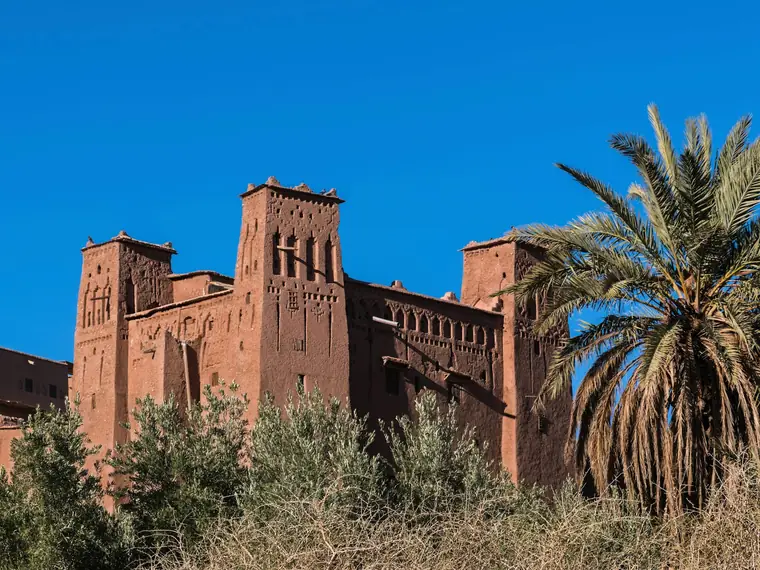
A corridor rich in trade but far from any central authority was a dangerous place. The settled farmers of the oases lived under threat from nomadic tribes, from rival villages and from one another in disputes over water and land. So they built for defence. A kasbah, called a tighremt in Tamazight, is the fortified house of an extended family: a tall square block with a tower at each corner, few openings at ground level and a single stout door. Animals lived on the ground floor, stores of grain and dates above them, and the family at the top.
A ksar is the same idea on the scale of a village, with many houses inside one wall. Wealthy families built bigger and more decorated towers as a sign of status, and powerful lords such as the Glaoui added their own strongholds at strategic points. The result, over three or four centuries, is the landscape you see today.
02Built of Earth
Everything is made from the ground it stands on. The lower walls are of pisé: moist earth, sometimes mixed with gravel and straw, tipped into a wooden frame and beaten down hard with a rammer, then left to dry before the frame is moved up for the next layer. You can often see the horizontal joints and the holes left by the timbers.
The upper parts are of adobe, sun-dried bricks, which are lighter and allow decoration. Here the builders set the bricks in and out to make patterns: lozenges, chevrons, zigzags, blind arches and stepped battlements. Each region and sometimes each family had its preferred motifs, and they are believed to have a protective meaning as well as a decorative one.
Earth keeps a house cool in summer and holds the warmth in winter. But rain dissolves it. Walls must be replastered every year or two, and when a family moves to a concrete house beside the road, as many have, the kasbah is left to the weather. Within a generation the roof falls and the towers begin to melt. That is why so many of the “thousand” are romantic ruins, and why those that have been restored, as museums, guesthouses or family homes, deserve support.
03Skoura: The Palm Grove of Kasbahs
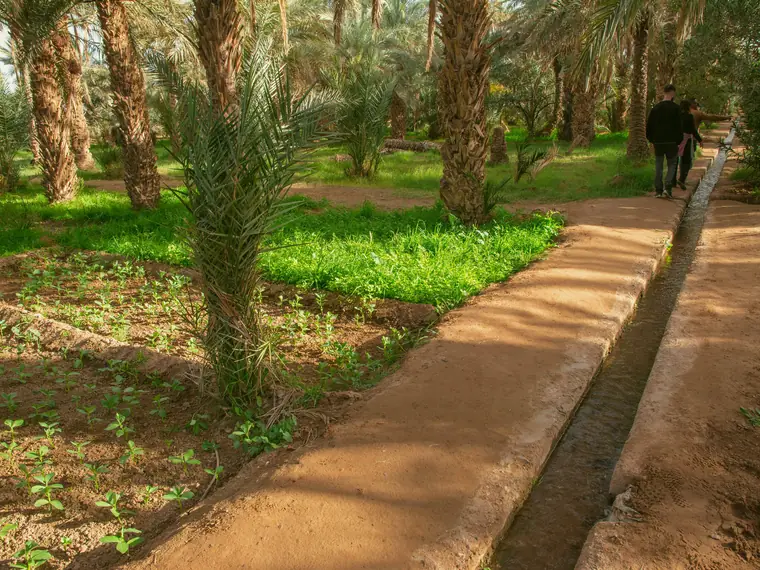
The first oasis east of Ouarzazate is also the one with the greatest concentration of kasbahs. Skoura is a wide palm grove, some of it dating back, according to tradition, to the Almohad sultans of the twelfth century. Under the date palms grow olives, almonds, pomegranates, figs and plots of barley and alfalfa, watered by a web of earthen channels.
Leave the main road and take one of the tracks into the grove. Kasbahs appear on every side, some in ruins, some lived in. The most famous is Amridil, built in the seventeenth century, whose elegant towers once appeared on the Moroccan fifty-dirham note. Part of it is open as a museum of rural life, with its bread ovens, oil press, stables and family rooms. Nearby stand Ben Moro, restored as a guesthouse, and the lofty Aït Abou.
The best way to see Skoura is on foot, with a local guide, for an hour or two. You walk between garden walls in the shade, cross dry riverbeds, greet farmers at work, and come upon towers rising above the palms. Many travellers who stop for a short visit wish they had planned a night here.
04Kalaat M’Gouna and the Valley of Roses
Fifty kilometres further, the M’Goun river joins the Dades at Kalaat M’Gouna, a busy town at about 1,450 metres whose name means “fortress of the M’Goun”. This is the centre of Morocco’s rose-growing region. Damask roses are planted as hedges around the fields, and in late April and May their small pink flowers are picked at dawn and taken to the distilleries of the town to be made into rose water and essential oil.
The harvest is celebrated with a festival in May. All year round, shops along the main street sell rose water, soaps and creams, and you will smell the town before you see it. The area is also known for its daggers, made by craftsmen in a nearby village.
For scenery, turn north up the valley of the M’Goun towards Hdida and Bou Tharar. The road winds above a river lined with gardens, rose hedges and kasbahs, with the high snows of the M’Goun massif, at over 4,000 metres, ahead.
05Boumalne and the Dades Gorge
At Boumalne Dades the main road crosses the river, and a side road follows it north into the mountains. For the first twenty-five kilometres the Dades Valley is a succession of villages and kasbahs set against cliffs of red and mauve rock, with gardens of fig, almond and poplar along the water. At Aït Arbi and Aït Youl the old houses stand directly beneath spectacular eroded rock walls.
At Tamellalt, an entire hillside has been weathered into smooth, rounded pillars that the locals call the “monkey fingers”. Further on, the valley narrows to a true gorge, and the road climbs its side in a famous stack of hairpin bends, with a café at the top looking down on them.
The Dades is where most travellers on their way to the desert spend the night, in guesthouses with terraces over the river. At 1,500 metres and more, the evenings are cool and the stars are bright.
On this road the eye never rests: a tower here, a palm grove there, and always the mountains on both sides.

06Tinghir and the Todra Gorge
Between Boumalne and Tinghir the road crosses a high, empty plateau, with the Saghro on the right and wide views in every direction. Then Tinghir appears: a large town on a terrace above one of the most beautiful palm groves in the south. Stop at the viewpoint on the way in. Below you, a dense river of palms winds between ochre villages, some inhabited, some crumbling, with the ruins of a Glaoui kasbah on the hill and the wall of the Atlas behind. Tinghir’s old ksar includes a former Jewish quarter, a reminder of the communities that lived throughout these valleys.
A road follows the palms upstream for fifteen kilometres to the Todra Gorge. Here the river has cut a slot through the limestone: cliffs about three hundred metres high stand barely ten metres apart at the narrowest point, and a clear, cold stream runs along the bottom. It is cool even at midday. You can walk through in a few minutes or continue along the valley beyond; rock climbers come from all over the world for the walls.
This is the traditional end of the Road of a Thousand Kasbahs. Beyond Tinghir the valley opens towards Tinejdad, with its restored ksar of El Khorbat and small museums of oasis life, and on to Erfoud, Rissani and the dunes of Merzouga.
07Distances Along the Road
Approximate distances from Ouarzazate, travelling east on the N10.
- Skoura40 km · about 40 minutes
- Kalaat M’Gouna90 km · about 1 hour 30
- Boumalne Dades115 km · about 2 hours
- Tinghir170 km · about 2 hours 45; Todra Gorge 15 km further
08How Long to Allow
You can drive the whole road in under three hours, and people who do so see almost nothing. Its pleasures are on the side roads and on foot. As a minimum, give it a full day with a night in the Dades or near the Todra, which is how it fits into a classic three or four-day tour from Marrakech to Merzouga.
With two days you can do it justice: a walk in the palm grove of Skoura and a night there or in the Valley of Roses, then the Dades in the morning light, lunch by the river and the Todra in the afternoon. With three, add a half-day hike in the M’Goun valley or the canyons of the Dades. Walkers, photographers and anyone travelling in spring should take the slower version.
09When to Go
The valley lies between 1,100 and 1,600 metres, so it is cooler than the desert and warmer than the mountains.
 Spring (Mar – May)Almond blossom, green barley, roses in May, snow on the Atlas.
 Summer (Jun – Aug)Hot on the road, cool in the gorges and at night.
- Autumn (Sep – Nov)Dates, pomegranates and golden poplars; clear, steady weather.
 Winter (Dec – Feb)Bright cold days, frosty nights, kasbahs against white peaks.
10Travel Tips
To get the best from the road:
- Stop oftenThe best views are rarely signposted. A driver who knows the road knows where to pull over.
- Walk in an oasisAn hour on foot in Skoura or Tinghir, with a local guide, is worth more than three kasbahs seen from the car.
- Visit one kasbah insideAmridil is the classic choice, and shows how such a house actually worked.
- Sleep in earthChoose at least one restored kasbah or earthen guesthouse. Your stay helps keep traditional building alive.
- Market daysBoumalne on Wednesday, Kalaat M’Gouna on Wednesday, Tinghir on Monday: lively, local and worth a stop.
- LightEast to west in the afternoon, or west to east in the morning, the sun is behind you and the kasbahs glow.
- CashBank machines in Ouarzazate, Kalaat M’Gouna, Boumalne and Tinghir; few elsewhere.
11Road of a Thousand Kasbahs: Frequently Asked Questions
Where is the Road of a Thousand Kasbahs?
In southern Morocco, between Ouarzazate and Tinghir, along the valley of the Dades on the southern side of the High Atlas.
Are there really a thousand kasbahs?
The name is poetic rather than a count, but the valley does contain hundreds of kasbahs and fortified villages, many in ruins.
What is the difference between a kasbah and a ksar?
A kasbah is the fortified house of one family. A ksar is a fortified village containing many houses.
How long does it take to drive?
Under three hours without stopping, but at least one full day and a night are recommended to enjoy it.
Which is the best kasbah to visit?
Kasbah Amridil in Skoura is the best preserved and is open as a museum of traditional life.