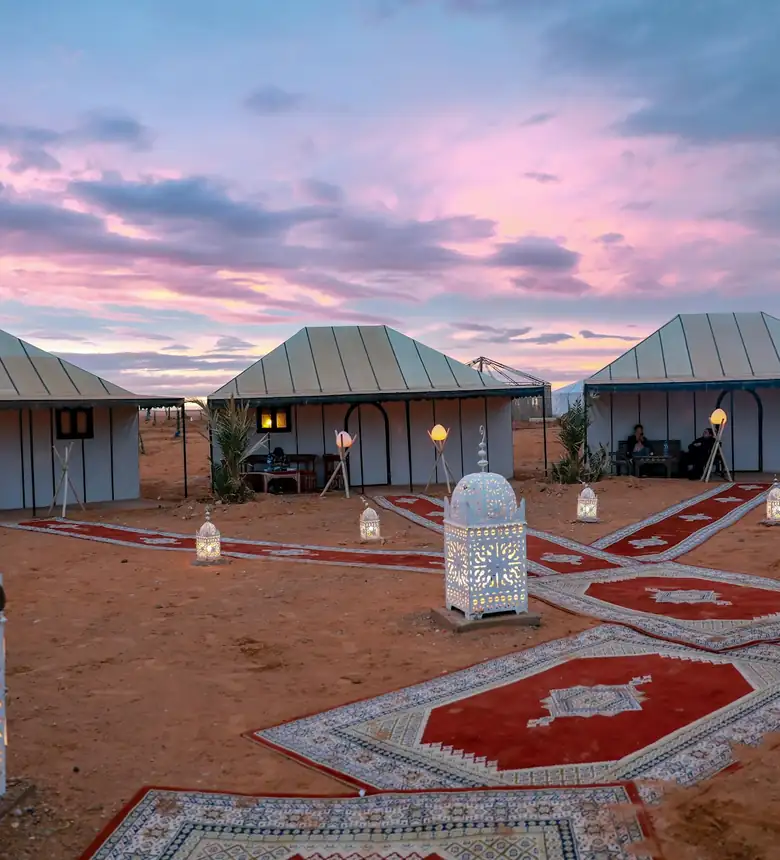
Photographs of desert camps show lantern-lit tents, carpets on the sand and a sky full of stars. They do not tell you whether there is a real bed, whether the shower is hot, what you will eat, how cold it gets at three in the morning or what there is to do after dinner. These are the things travellers actually want to know before they book. This article follows a night in a camp in Erg Chebbi, near Merzouga, from the moment you arrive to the moment you leave, and explains the difference between the two categories of camp we work with. Here is what a Merzouga desert camp is honestly like.
01Where the Camps Are
Erg Chebbi is a sea of dunes about twenty-eight kilometres long on the eastern edge of Morocco. The village of Merzouga and its neighbours lie along its western side, where the sand meets a flat plain of dark gravel. The camps are set inside the erg, usually in a hollow between high dunes, so that once you are there you see nothing but sand in every direction.
Some are only a little way in, twenty minutes from the edge; others are deeper, an hour or more by camel. Distance is not a measure of quality. A camp well tucked behind a dune feels completely remote even if the village is not far, and one that is closer in is more convenient for families and for those who prefer a short ride. All are reached either by camel or by 4x4, and your main luggage stays behind in Merzouga, so you bring only an overnight bag.
02Late Afternoon: Arrival
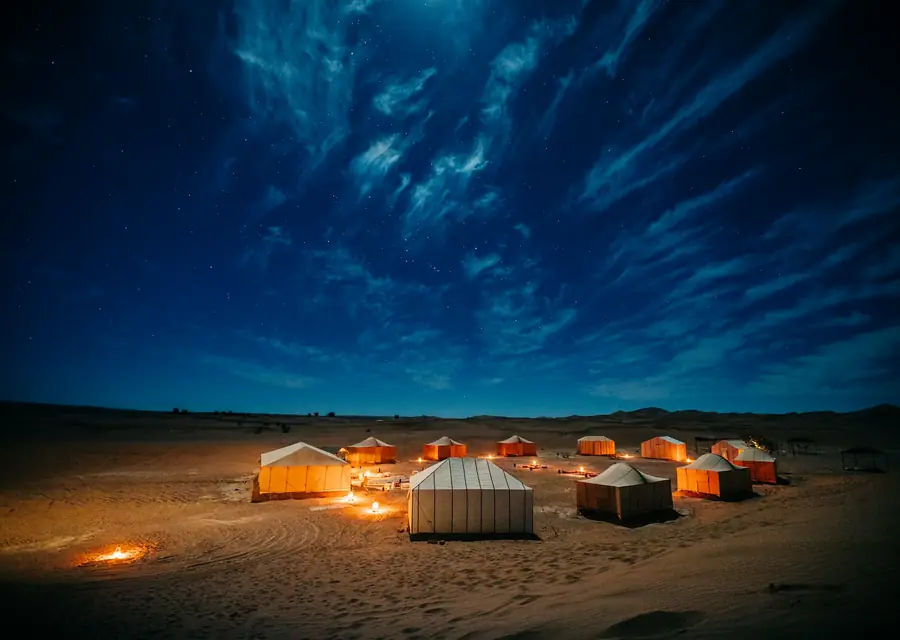
Most guests arrive on the back of a camel, having stopped on the way to climb a dune and watch the sunset. You come over a last ridge and see the camp below: a circle or a line of tents, paths marked with lanterns, a larger tent for meals and a fire pit in the middle. It is dusk, and the sand is turning from orange to mauve.
The camp team are waiting. They take your bag, and before anything else you are sat down on cushions and given mint tea with peanuts or biscuits. This is the desert welcome and it is not to be hurried. Then you are shown to your tent and told the time of dinner.
There is usually an hour to yourself. Some people shower and change, some lie on the bed with the tent door open, and many climb the nearest dune in the last light. The silence is the thing everyone remarks on. With no traffic, no machinery and sand absorbing every sound, you can hear your own breathing.

03Your Tent
Forget camping. In the camps we use, a tent is a room. The frame is solid, the walls are of heavy canvas or woven wool lined inside with fabric, and the floor is covered with carpets. There is a proper bed with a mattress, sheets, pillows and thick blankets, bedside tables, lamps, a place for your bag and sockets for charging. A door or a zipped flap closes it against wind and sand.
Each tent has its own private bathroom at the back, with a flush toilet, a washbasin and a shower with hot water. Towels and basic toiletries are provided. Electricity generally comes from solar panels, sometimes with a generator in support, so there is light all evening; in some camps power for sockets is limited to certain hours.
A reasonable caution: this is still the desert. A little sand finds its way in, hot water may take a minute to arrive, and Wi-Fi, where it exists, is slow. Most guests find that these small reminders of where they are add to the pleasure rather than spoil it.
04Two Categories of Camp
We work with two levels of camp in Erg Chebbi. Both give you privacy, a real bed and your own bathroom; they differ in space, equipment and service.
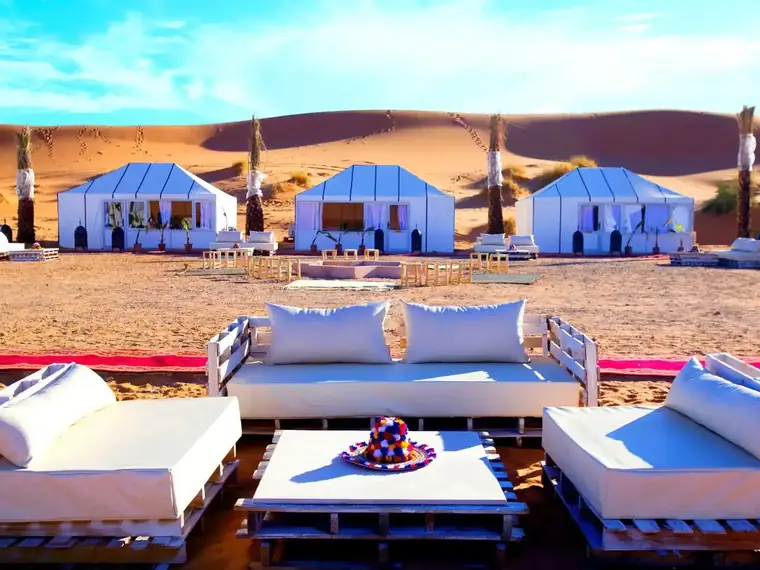
- Mid-range luxury campPrivate tents with en-suite bathrooms, hot showers and comfortable bedding. A balance of comfort and authenticity.
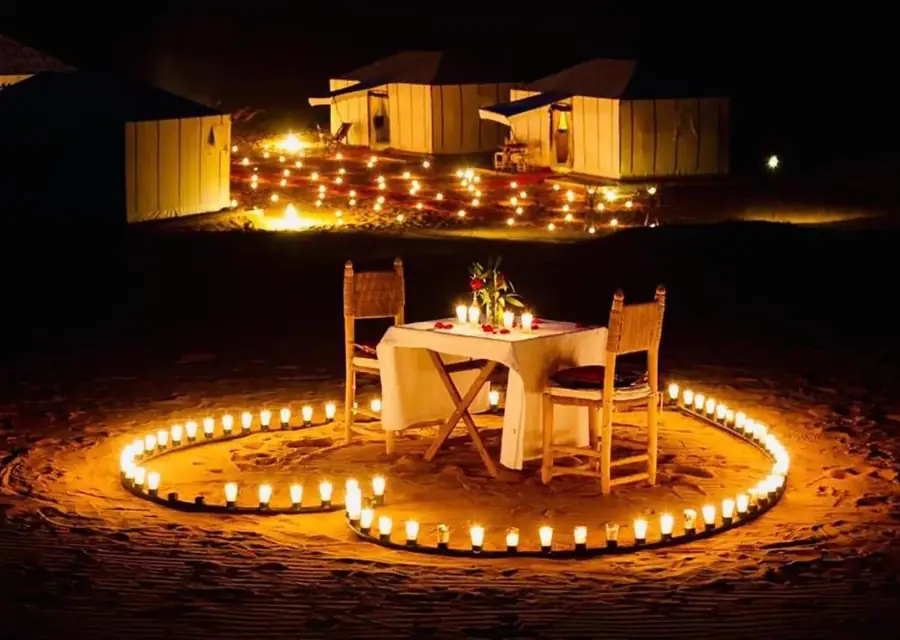
 Luxury campSpacious private tents with en-suite bathrooms, air conditioning and heating, high-quality bedding and elegant traditional décor.
 Both includeDinner and breakfast, tea on arrival, music by the fire and the help of the camp team throughout.
 Luxury addsHot showers with premium amenities, maximum privacy and a more personalised service.
05Which Should You Choose?
The mid-range luxury camp suits most travellers very well. You sleep comfortably, wash in hot water and enjoy the same dunes, the same dinner under canvas and the same sky. It keeps something of the simplicity that makes a night in the desert feel like an adventure.
The luxury camp is worth choosing in three cases. In winter, from December to February, heating in the tent makes a real difference when the night falls close to freezing. In the hot months, from late May to September, air conditioning lets you rest properly. And for a honeymoon, an anniversary or any occasion when you want more space, finer linen, a more elegant setting and more attentive service, it turns the night into a highlight of the whole journey.
06Evening: Dinner under Canvas
Dinner is served in the restaurant tent, or outside under the sky when the weather allows, at tables set with cloths and lanterns. It follows the pattern of a Moroccan family meal. First comes harira or a vegetable soup, or a selection of cooked salads with bread. Then the main dish: a tagine, most often chicken with lemon and olives or beef with vegetables and prunes, sometimes accompanied by couscous or rice. Dessert is fresh fruit, oranges with cinnamon or a pastry, followed by mint tea.
The food is prepared in the camp kitchen by cooks who work with what can be brought in across the sand each day, and it is usually generous and good. Vegetarian meals are easy to arrange, and other diets and allergies can be catered for if we know in advance. Bottled water is provided. Alcohol is not generally sold in the camps; if you would like wine with dinner, ask us beforehand what is possible.
07Night: The Fire and the Drums
After dinner everyone drifts towards the fire. The men who led your camels, cooked your meal and carried your bag now bring out drums, iron castanets and sometimes a lute, and begin to play. This is the music of the desert, Amazigh rhythms and the songs of the Gnawa, repetitive and hypnotic, with a beat that builds slowly.
You are welcome to listen from your cushion or to join in. A drum will be put in your hands sooner or later, and nobody minds how you play it. There is laughter, some dancing, perhaps a few riddles and jokes, and tea. It is unpolished and good-humoured, and it has been the evening entertainment of desert people for generations. If you would rather have quiet, simply walk fifty metres from the fire. The sound fades quickly among the dunes.
08The Stars
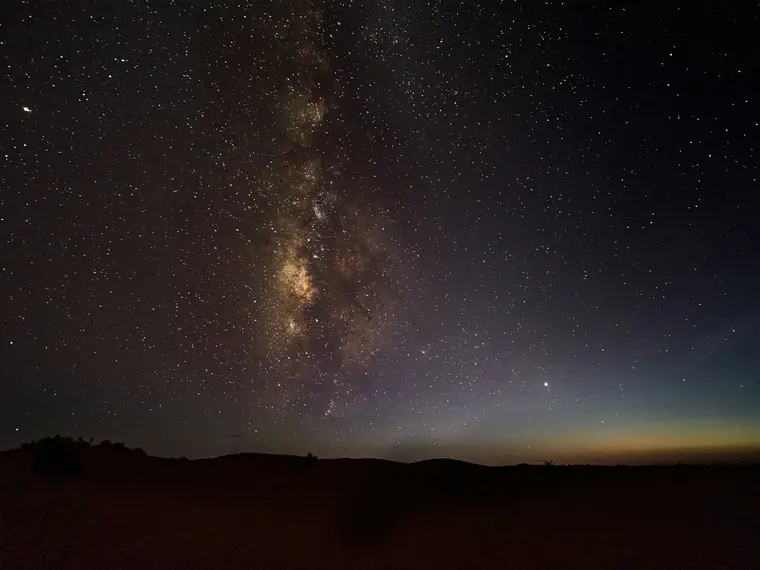
When the fire dies down, look up. Merzouga is far from any city, the air is dry, and on most nights of the year the sky is completely clear. Away from the lamps of the camp, the number of stars is astonishing. The Milky Way runs overhead as a bright band, and you will see shooting stars and satellites without trying.
For the best view, walk a little way up a dune, lie back on the cool sand and let your eyes adjust for ten minutes. A night around the new moon is darkest and best for stars and for photographing the Milky Way. A full moon is different and just as beautiful: the dunes turn silver, and you can walk without a torch and see your shadow.
Phones and cameras can capture it if you set a long exposure and rest the device on something steady. A small tripod is worth packing.
Many guests tell us the same thing afterwards: they had forgotten what a truly dark sky looks like.
09Sleeping in the Desert
People sleep well in the desert, between the fresh air, the exercise and the quiet. The bed is comfortable and the blankets are heavy. How warm you are depends on the season. From April to October nights are mild or warm. From November to March they are cold, and in December and January the temperature outside can fall to around zero before dawn. In a tent without heating, you will be glad of warm sleepwear, socks and the extra blankets provided; in a luxury tent the heater takes care of it.
Occasionally the wind rises at night and the canvas moves and creaks. It is nothing to worry about. If you wake in the small hours, step outside for a moment: the camp is dark, the sky is at its most brilliant, and the stillness is complete.
10Morning: Sunrise and Departure
Someone will knock on your tent about forty minutes before sunrise, if you have asked to be woken. Put on everything warm you have and climb the dune behind the camp. The sky lightens from grey to pale yellow, the sand is cold under your feet, and then the sun comes up over the Algerian border and the dunes catch fire, ridge by ridge. Look at the sand around you: it is covered with the tiny tracks of beetles, lizards and desert mice that were busy in the night.
Breakfast follows: bread and pancakes, jam, honey, olive oil, cheese, boiled eggs, orange juice, coffee and tea. Then you ride or drive back to Merzouga in the fresh morning light, where you can shower again if you wish and collect your luggage before the day’s journey. Travellers staying a second night have the whole day for a 4x4 circuit, sandboarding, a visit to a nomad family or simply doing nothing at all.
11Good to Know
A few honest details:
- BathroomsPrivate and en suite in both categories of camp we use, with flush toilets and hot showers.
- ChargingSockets are available. Bring a power bank in case power is limited at certain hours.
- Phone signalOften present but not guaranteed. Wi-Fi, where offered, is basic.
- Insects and animalsThere are very few insects. Scorpions and snakes live in the Sahara but are rarely seen in camps; keep your tent closed and shake out your shoes in the morning.
- SandstormsOccasional, mostly in spring. The team will adapt the programme, and the tents are secure.
- ChildrenChildren love the camps. Family tents or adjoining tents can be arranged.
- One night or twoOne night gives you the full experience. Two let you slow down and see the desert by day.
- TippingA tip for the camp team and the camel men is customary and appreciated.
12Merzouga Desert Camp: Frequently Asked Questions
Do desert camps have private bathrooms?
The mid-range luxury and luxury camps we work with both have private en-suite bathrooms with hot showers and flush toilets.
Is it cold at night in a desert camp?
In winter, yes. Nights can approach freezing from December to February. Camps provide thick blankets, and luxury tents have heating.
What is the food like?
A Moroccan dinner of soup or salads, a tagine and fruit, with breakfast the next morning. Special diets can be arranged in advance.
Is there electricity?
Yes, for lighting and charging, usually from solar power.
What is the difference between a mid-range luxury camp and a luxury camp?
Both have private tents with bathrooms. The luxury camp offers more spacious tents, air conditioning and heating, higher-quality bedding and décor, premium amenities and more personalised service.